Leaders Tech Talk: Emerging IT Trends: Cloud, Security & Resilience in Practice


APP


Emerging IT Trends: Cloud, Security & Resilience in Practice
-
 Harshit Singh
- 04-Aug-2026
- 104 Views
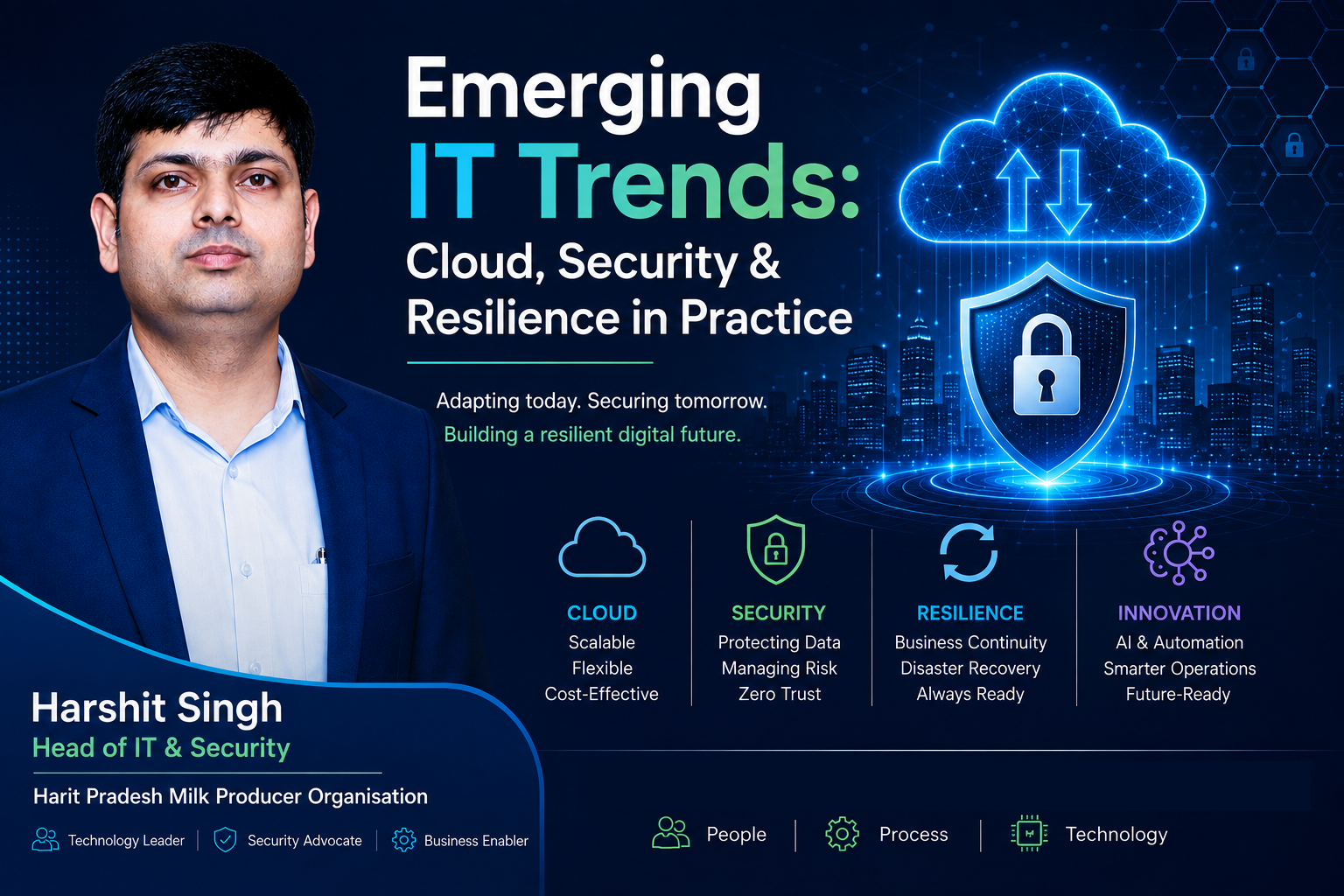
Simply having your IT systems working isn't sufficient anymore. It's now essential to bounce back from problems, protect your data from dangers and be flexible as things evolve because difficulties appear very quickly. Each year, these issues are harder to deal with. Cyberattacks are becoming more sophisticated, cloud computing is increasingly important for all operations and the amount of legal and other requirements continues to grow. There isn't a way to avoid this. Businesses must fundamentally change the way they create and manage their basic IT structure.
What’s influencing IT right now includes these developments and approaches businesses are really using:
- Cloud ERP solutions
especially SAP S/4HANA.
- The tried and true 3-2-1
backup method.
- Cooperating cybersecurity
on many levels.
- Continuous monitoring for
rule following and auditing.
Cloud ERP Transformation with SAP S/4HANA: The first thing to understand is cloud ERP and SAP S/4HANA is the most popular choice. It provides up-to-the-minute data and a system that grows or shrinks with your business.
- Real-time data processing.
- High-speed performance.
- Scalability aligned with
business growth.
- Continuous system
availability.
SAP S/4HANA is incredibly fast for processing,
offers flexibility through being on the cloud and avoids interruptions as cloud
ERPs are working all the time. If you’re nervous about using the public cloud,
a private cloud allows for growth but you maintain control of who can get in
and your security. You can easily adjust your scale without losing that
control.
You simply can't achieve true digital transformation/atomization
in a business without a ERP system that is based in the cloud.
From Backup to Data Resilience: Backups aren’t optional anymore. If you want to keep your
company’s info safe (and stay one step ahead of ransomware), you need them.
- Three copies of your data.
- Two types of storage
media.
- One backup kept offsite.
Store important files somewhere reliable like NAS encrypt them and
use MFA. Update/restore backups regularly. Add new files as you go so that if
anything messes up your system, you can get back to work fast.
Having backups isn’t enough. You need to bounce back, every time.
Multi-Layered Cybersecurity: Next-Generation Antivirus (NGAV), DLP
& MFA: These days, Antivirus
software isn't enough for security, you can't simply install it and not think
about it again. Instead, you need to build up protection in stages, with each
stage making your defenses more robust.
Artificial Intelligence & Machine Learning: Programs use smart algorithms to study
file patterns and catch brand-new or unknown ("zero-day") threats
without needing old-style virus list updates.
Behavioral Detection: Instead of just looking for a known virus file, software
watches how apps act in real time. If a program tries to lock files or steal
data, the system stops it immediately.
Cloud-Based Architecture: Heavy scanning and massive threat databases live in the
cloud. This makes the software run fast on your device without slowing down
your computer.
The Next-Generation Antivirus (NGAV) will prevent
problems from happening and halt threats immediately. Data Loss Prevention
(DLP) monitors confidential information both within and beyond the boundaries
of your organization, to stop it from being revealed. And then there's
Multi-Factor Authentication, if someone manages to get hold of your password,
they still won't be able to access anything.
- Devices (through
Next-Generation Antivirus (NGAV)).
- Data (through DLP).
- Access (through MFA).
Combine Next-Generation Antivirus (NGAV), DLP
and MFA and you are safeguarding your entire business, your information and all
the people using it. This is even more important now that so many are working
remotely and using the cloud as their main place of work.
In short, strong security is all about having layers. Everything -
your equipment, your data, and your staff needs to be covered.
Continuous Compliance & Audit Readiness: Checking if you’re doing things correctly isn't
just something you do once a year anymore. Audits are now happening
constantly.
In fact, audits are much more frequent, security
is being monitored at the moment it’s happening, and cybersecurity and
protecting people’s private information are the biggest priorities. Just make
sure things continue to function smoothly, integrate these guidelines into your
routine. Specifically, limit access to information to only those who need it,
keep a log of all activity, routinely verify your data is being backed up and use
two-factor authentication for every account. When you normally do these things
a surprise security review won't be so worrying.
It's important to remember that compliance shouldn't be something
you do in an emergency, it's simply a part of the job.
The Convergence of Modern IT: Looking at the whole of modern IT, it isn't a collection of
isolated pieces. Cloud, backups, security, and compliance are all connected and
are part of a single plan. The cloud allows for quick growth, backups allow you
to get back on your feet after a problem, security defends against dangers,
multi-factor authentication safeguards your accounts and compliance holds it
all together.
A well-thought-out plan will mean your IT can
handle anything.
The way we did IT in the past just isn't good
enough now. You need a clever combination of how well it works, how secure it
is, and following the rules, without any weaknesses.
Migrate your organization to the
cloud-based SAP S/4HANA solution.
Adopt the 3-2-1 approach to data backup. Deploy all four categories of security
solutions – Next-Generation Antivirus (NGAV) protection, data loss prevention tools, multifactor authentication, and email security.
Compliance needs to be an ongoing process, do not leave it for the
last minute.
Nowadays, when everything related to AI,
cybersecurity, new technology and programming is changing very quickly, the
main priority for the IT sector of tomorrow will be establishing a solid
reputation of reliability, resiliency and foresight. It is important to be
ready for evolution and adaptation because the capability to bounce back after
an error and continue further development will be highly appreciated in the
future.

 Team IndiaIT360

Ad
Tech Titans Speak



















Poll of the Week
What’s your biggest challenge in scaling your SaaS platform?
Which VDI platform do you currently use or prefer using?
What is driving your organization to reconsider its VDI strategy today?
What would help you grow your business faster as a channel partner?
How ready is your payments ecosystem for AI-driven automation?
What matters most in your cloud journey?
What's your biggest IT headache?
How do you prefer to stay updated on emerging tech trends?
Which breakthrough technology would most elevate your endpoint security?

Ad
Teaser of the Week