Ad


What Tech Leaders Want Students to Know Before Entering the Industry in 2026
-
 Team IndiaIT360
- 27-May-2026
- 1255 Views
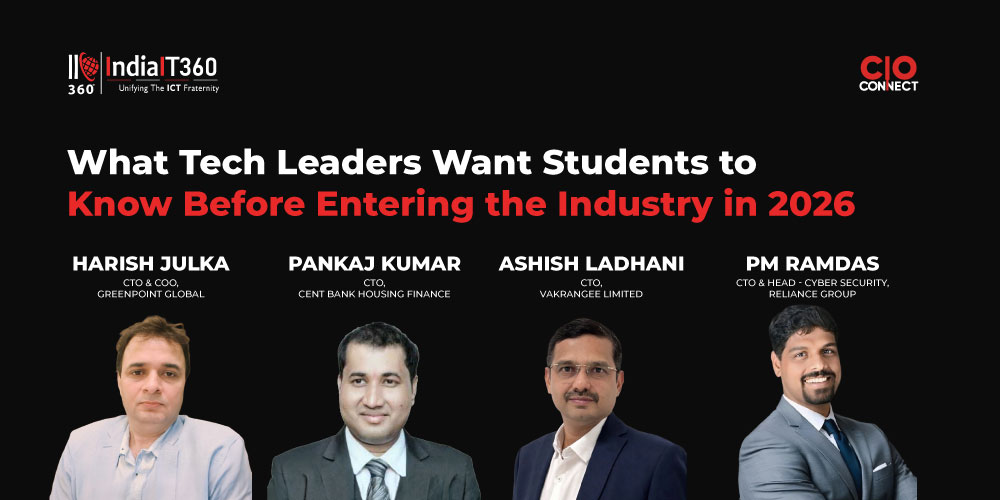
We asked a few top technology leaders a question that is buzzing across the industry today:
What advice would you give to students entering the tech industry in 2026?
What skills, mindset, and opportunities should they focus on to build a successful future in tech?
As the technology landscape continues to evolve with AI, cybersecurity, cloud, automation, and intelligent data systems shaping the future, the expectations from young professionals are changing rapidly. Companies today are looking beyond technical qualifications for individuals who can adapt, think critically, communicate effectively, and solve real business challenges.
From the importance of continuous learning and strong fundamentals to the growing role of AI and leadership skills, industry leaders shared their perspectives on what the next generation needs to succeed in the years ahead.
Here’s what some of India’s respected technology leaders and CIOs had to say.
According to Pankaj Kumar, technical expertise alone will no longer define long-term success.
“As technology continues to redefine every industry, students entering the tech sector in 2026 should focus on building strong fundamentals, adaptability, and a continuous learning mindset. AI, cybersecurity, cloud, data intelligence, and automation will drive the next phase of digital transformation, but long-term success will come from the ability to solve real business challenges through technology.”
He further emphasises that analytical thinking, communication, collaboration, and execution capabilities will become equally important for future professionals.
“The future will belong to professionals who can combine technology excellence with business understanding and customer-centric thinking.”
For Ashish Ladhani, curiosity and consistency in learning remain the biggest differentiators in today’s rapidly changing environment.
“My advice to students entering the tech industry in 2026 would be to stay curious and never stop learning. Technology is evolving faster than ever, and the people who grow consistently will always stay relevant.”
He encourages students to build expertise in emerging domains such as AI, cybersecurity, cloud computing, automation, and data analytics while strengthening their fundamentals through practical exposure.
“Certifications help, but practical exposure creates real confidence.”
Ashish also believes adaptability and the willingness to embrace change will shape future careers more than technical skills alone.
“A positive attitude, discipline, and continuous improvement will take you much further than just technical skills alone.”
Highlighting the growing influence of next-generation AI systems, Harish Julka points toward one of the most significant trends shaping the future of enterprise technology.
“Focus on Gen AI technologies, especially on Agentic AI and Autonomous Agents.”
As organisations increasingly adopt intelligent automation and AI-driven decision-making, expertise in these technologies is expected to play a critical role across industries in the years ahead.
For PM Ramdas, the defining factor for future professionals will not only be their technical knowledge, but also their mindset and discipline.
“Technology is changing faster than any generation has ever seen. Tools will keep changing, platforms will keep evolving, and AI will keep disrupting industries. What will truly differentiate you in 2026 and beyond is not just your technical knowledge, but your mindset.”
He strongly advocates the importance of continuous learning and adaptability.
“The technologies you study today may evolve tomorrow. Curiosity and adaptability will become your biggest superpowers.”
At the same time, he cautions students against depending entirely on automation and shortcuts.
“AI can write code. Automation can deploy systems. But critical thinking, problem solving, architecture understanding, and cybersecurity awareness cannot be outsourced.”
PM Ramdas also highlights the growing need for communication and leadership skills in the technology ecosystem.
“The future belongs to people who can explain complex ideas in simple ways, work across teams, and lead with clarity.”
Drawing from his own leadership journey, he underlines the value of discipline and consistency in building long-term success.
“In my journey from the Indian Navy to leading large-scale cybersecurity transformations, one thing stayed constant: consistency beats talent when talent stops working hard.”
Preparing for the Future of Technology
As the industry moves toward an AI-first, data-driven, and highly connected future, technology leaders agree on one thing: success will belong to professionals who continue learning, stay adaptable, and build with responsibility.
The next decade will not only be shaped by smarter technologies, but by individuals who can use those technologies to solve real-world challenges with clarity, ethics, and purpose.
For students entering the workforce in 2026, the message from industry leaders is clear: build strong foundations, stay curious, embrace change, and never stop learning.

 Bhavna

eBook
Tech Titans Speak
















Poll of the Week
What’s your biggest challenge in scaling your SaaS platform?
Which VDI platform do you currently use or prefer using?
What is driving your organization to reconsider its VDI strategy today?
What would help you grow your business faster as a channel partner?
How ready is your payments ecosystem for AI-driven automation?
What matters most in your cloud journey?
What's your biggest IT headache?
How do you prefer to stay updated on emerging tech trends?
Which breakthrough technology would most elevate your endpoint security?

Ad
Teaser of the Week