APP


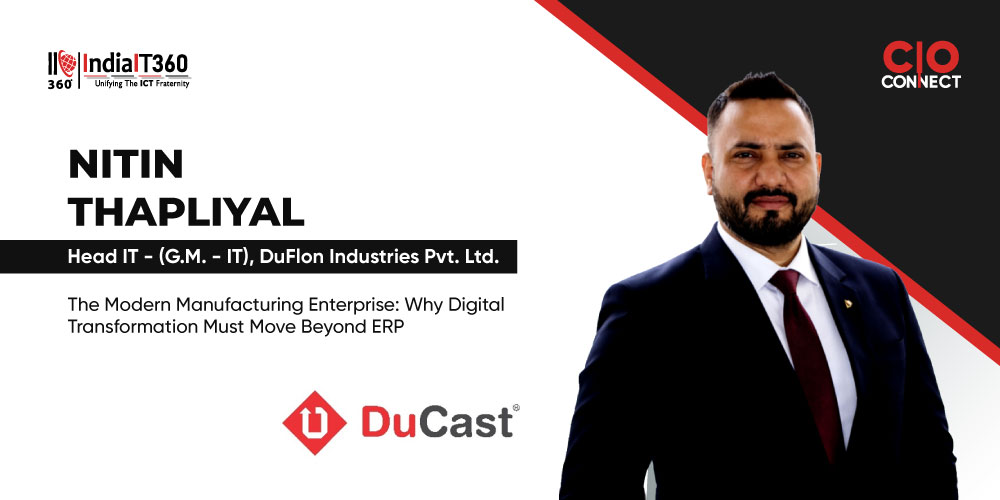
The Modern Manufacturing Enterprise: Why Digital Transformation Must Move Beyond ERP
-
 Bhavna
- 22-May-2026
- 1476 Views
For decades, ERP systems such as SAP/Oracle have been the operational backbone of manufacturing enterprises. They brought standardization across procurement, finance, production planning, inventory management, and supply chain operations. For many organizations, ERP implementation itself was considered a digital transformation.
That definition no longer holds
Today’s manufacturing environment is far more dynamic and unpredictable than it was even five years ago. Rising raw material costs, global supply chain disruptions, customer-specific production models, sustainability expectations, and increasing pressure on margins are forcing manufacturers to rethink how technology creates business value. In this environment, ERP alone cannot deliver the agility and intelligence modern enterprises require.
ERP is now the digital core, not the complete transformation strategy
The modern manufacturing enterprise is moving from a transactional model to an intelligent and connected ecosystem. Earlier, systems were designed primarily to capture transactions after activities were completed. Today, organizations need systems that can predict, analyze, automate, and recommend actions in real time.
Consider a manufacturing plant producing industrial or engineered components. Traditional ERP systems can record production output, inventory movement, and financial postings. However, they cannot independently predict machine failure, identify abnormal material consumption patterns, or simulate the impact of production inefficiencies on profitability. That capability comes from integrating ERP with Manufacturing Execution Systems (MES), Industrial IoT platforms, predictive analytics engines, and AI-driven planning tools.
This is where Industry 4.0 becomes a business necessity rather than a technology trend.
Leading manufacturing organizations are now building connected digital ecosystems in which machines, shop-floor operations, finance, procurement, and analytics work together seamlessly. Sensors on production equipment can trigger predictive maintenance alerts before breakdowns occur. AI models can analyze consumption variance and identify hidden cost leakages. Real-time dashboards can provide visibility into Overall Equipment Effectiveness (OEE), contribution margins, and plant-level profitability.
The result is not just automation, it is decision intelligence
One of the biggest shifts happening globally is the evolution of the CIO role itself. Historically, CIOs were viewed as technology custodians responsible for infrastructure, ERP implementation, and IT support. Today, the expectation is entirely different. Modern CIOs are becoming business transformation leaders who directly influence operational efficiency, profitability, and strategic growth.
This shift is particularly evident in manufacturing industries, where technology decisions now directly impact EBITDA, working capital, production throughput, and customer service levels. A predictive maintenance initiative, for example, is no longer just an IT deployment. It directly affects machine uptime, production continuity, inventory planning, and ultimately revenue realization.
Similarly, finance transformation is becoming deeply integrated with manufacturing operations. Organizations increasingly expect real-time profitability analysis, predictive costing, driver-based forecasting, and integrated business planning capabilities. In complex manufacturing environments with fluctuating raw material prices and multi-level BOM structures, finance visibility itself becomes a competitive advantage.
Data has emerged as one of the most strategic assets in the modern manufacturing enterprise. Yet many organizations still operate with fragmented systems, inconsistent master data, and disconnected reporting structures. Without a strong digital foundation, even advanced technologies like AI, machine learning, and automation fail to deliver sustainable value.
This is why leading organizations are investing heavily in integrated architectures, cloud platforms, API-led ecosystems, and governance-driven data strategies. The objective is no longer limited to process efficiency. The focus is shifting toward enterprise-wide visibility, faster decision-making, operational resilience, and predictive business capability.
The future manufacturing enterprise will not compete solely on product quality or pricing. It will compete on agility, intelligence, and the ability to make faster and better decisions than competitors.
ERP will continue to remain critical, but the next phase of transformation lies beyond ERP, in building connected, intelligent, and data-driven enterprises capable of adapting continuously to market realities.
Digital transformation today is no longer about implementing software. It is about building a smarter manufacturing enterprise.
Article is written and approved by Mr. Nitin Thapliyal, Head of Information Technology at DuFlon Industries Pvt Ltd.


 Team IndiaIT360

eBook
Tech Titans Speak














Poll of the Week
What’s your biggest challenge in scaling your SaaS platform?
Which VDI platform do you currently use or prefer using?
What is driving your organization to reconsider its VDI strategy today?
What would help you grow your business faster as a channel partner?
How ready is your payments ecosystem for AI-driven automation?
What matters most in your cloud journey?
What's your biggest IT headache?
How do you prefer to stay updated on emerging tech trends?
Which breakthrough technology would most elevate your endpoint security?

Ad
Teaser of the Week