Leaders Tech Talk: Agentic Enterprise: Balancing AI Autonomy with Human Accountability


Ad


Agentic Enterprise: Balancing AI Autonomy with Human Accountability
-
 Team IndiaIT360
- 10-Aug-2026
- 82 Views
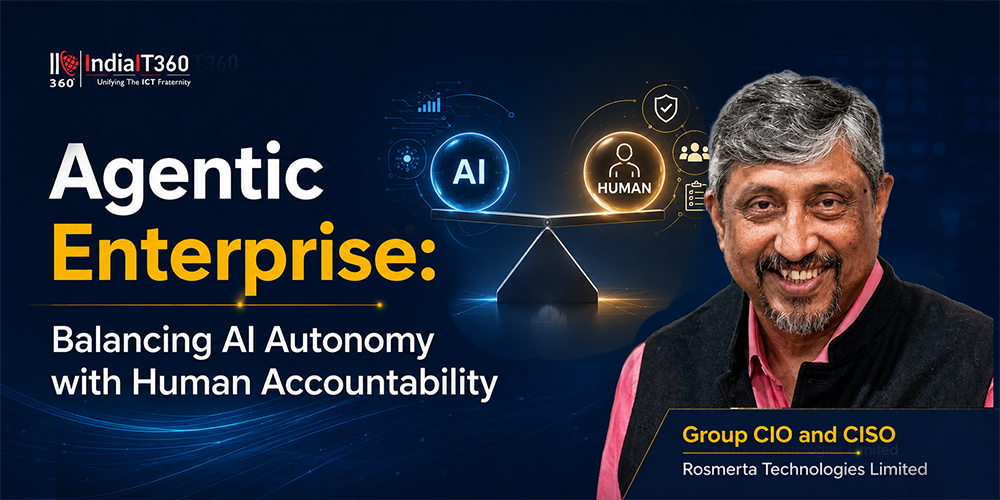
Artificial Intelligence is moving beyond chatbots and simple automation. Today, organisations are entering the era of the Agentic Enterprise, where AI agents can understand goals, make decisions, execute tasks and work with other systems with limited human intervention.
This can bring significant benefits to businesses. AI agents can improve productivity, reduce operational costs, respond faster and help employees make better decisions. However, greater AI autonomy also creates an important question: Who is responsible when an AI agent makes a wrong decision?
The answer cannot simply be “the AI.”
AI Can Act, But Humans Must Remain Accountable
An AI agent may be able to approve a transaction, respond to a customer, create a report, analyse data or trigger a business process. But the organisation must clearly define the boundaries within which the agent can operate.
Human accountability should remain at the centre of the Agentic Enterprise. Leaders must decide what AI can do independently, where human approval is required and what actions should never be delegated completely to AI.
For example, an AI agent may be allowed to identify a suspicious transaction, but the final decision to block a major customer account may require human approval.
Clear Responsibilities Are Essential
Every AI agent should have a clearly defined owner. This does not necessarily mean that one person must monitor the agent every minute. Instead, there should be clear responsibility for its objectives, data, performance, security and decisions.
Business teams should own the business outcomes, while technology and security teams should ensure that the underlying systems are reliable and secure. Data teams should focus on data quality and governance. Senior leadership should establish the overall AI governance framework.
Security and Privacy Cannot Be Ignored
Agentic AI introduces a new cybersecurity challenge because agents can potentially access systems, data and applications and take actions automatically.
Organisations therefore need strong identity and access controls, least-privilege access, continuous monitoring and clear audit trails. Every important action taken by an AI agent should be traceable.
Data privacy is equally important. Organisations must know what information an agent can access, where that information goes and how it is being used.
Human Oversight Should Be Risk-Based
Not every AI decision needs human approval. If humans have to approve every small action, the organisation will lose much of the benefit of automation.
A better approach is risk-based human oversight.
Low-risk activities can be fully automated. Medium-risk decisions can have human review or exception handling. High-risk decisions involving money, safety, legal matters, employees or customers should have stronger human control.
Building Trust in the Agentic Enterprise
The success of Agentic AI will depend not only on technology but also on trust.
Organisations should regularly test AI agents, monitor their behaviour, review their decisions and establish clear processes for stopping or correcting an agent when required.
The goal should not be to replace human responsibility with AI. The goal should be to combine AI autonomy with human judgement.
The Agentic Enterprise will be successful when AI agents are empowered to act, but humans remain accountable for the outcomes.
AI can make decisions faster. Humans must ensure that those decisions are responsible, ethical, secure and aligned with the organisation’s goals.
Artile is Written by Mr. Sujoy Brahmachari, Group CIO and CISO at Rosmerta Technologies Limited

Related Posts
 Harshit Singh

Ad
Tech Titans Speak


























Poll of the Week
What’s your biggest challenge in scaling your SaaS platform?
Which VDI platform do you currently use or prefer using?
What is driving your organization to reconsider its VDI strategy today?
What would help you grow your business faster as a channel partner?
How ready is your payments ecosystem for AI-driven automation?
What matters most in your cloud journey?
What's your biggest IT headache?
How do you prefer to stay updated on emerging tech trends?
Which breakthrough technology would most elevate your endpoint security?

Ad
Teaser of the Week