From Our Desk: The Best AI Apps Defining 2026: Inside the Modern AI Stack


Ad


The Best AI Apps Defining 2026: Inside the Modern AI Stack
-
 Team IndiaIT360
- 07-May-2026
- 62 Views
AI Is No Longer a Tool. It’s the Operating System of Modern Business.
The AI conversation has moved far beyond chatbots and image generators.
In 2026, AI is becoming the invisible infrastructure behind how businesses build software, create content, automate workflows, manage knowledge, and make decisions at scale. The real shift is not about one breakthrough application. It is about how multiple AI systems now work together as a connected stack.
From enterprise productivity to autonomous development environments, organizations are building layered AI ecosystems that function like digital operating systems for work.
The companies moving fastest are not simply “using AI.” They are architecting workflows around it.
Here’s a closer look at the AI applications shaping that transformation.
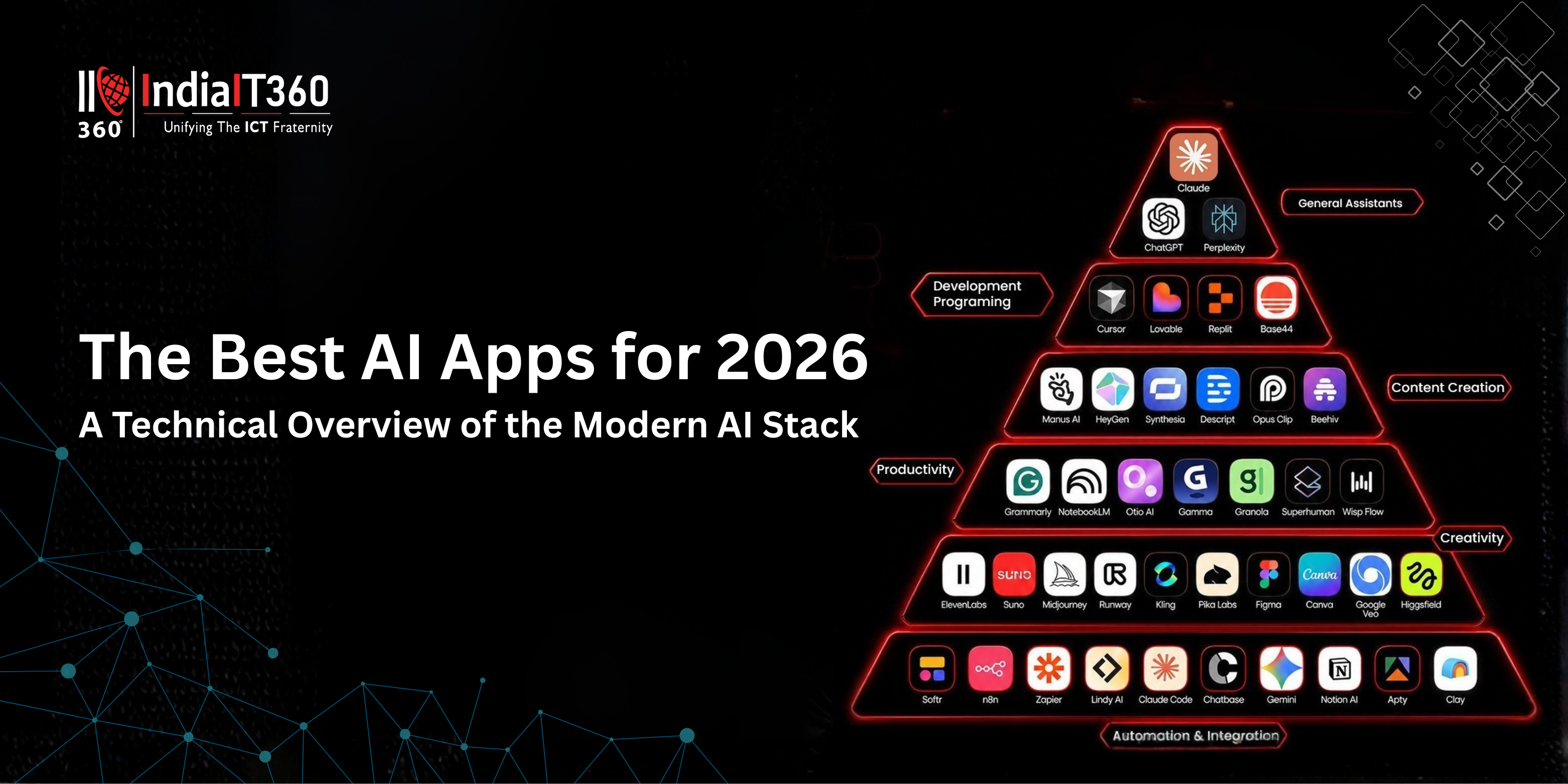
1. General AI Assistants: The Intelligence Layer
Every modern AI workflow starts with a reasoning engine. General-purpose AI assistants are now acting as the front-end interface between humans and machine intelligence, helping users search, analyze, write, summarize, code, and automate decisions in real time.
Leading Platforms
-
ChatGPT
-
Claude
-
Perplexity AI
These platforms are no longer standalone chat interfaces. They increasingly function as orchestration layers connected to APIs, enterprise systems, and workflow engines.
What makes them powerful in 2026 is context retention, long-form reasoning, multimodal processing, and real-time retrieval capabilities.
AI assistants are quickly becoming the “control center” of digital work.
2. AI-Powered Development Is Rewriting Software Engineering
Software development is undergoing one of the fastest transformations in technology history.
Developers are now collaborating with AI systems that can generate production-ready code, identify bugs, suggest optimizations, and even build applications from prompts.
Key Platforms
-
Cursor
-
Replit
-
Lovable
-
Base44
These platforms are reducing development cycles dramatically by automating repetitive engineering tasks and accelerating prototyping. The biggest change is not replacement. It is amplification. Developers now spend less time writing boilerplate code and more time solving architectural and business problems.
3. Content Creation Has Entered the Autonomous Era
AI-generated content is no longer experimental. It is operational.
Video production, audio editing, publishing, clipping, avatar generation, and scripting are increasingly being handled through AI-native media pipelines.
Platforms Driving the Shift
-
Manus AI
-
HeyGen
-
Synthesia
-
Descript
-
Opus Clip
-
Beehiiv
The evolution here is not just speed. It is scalability.
Marketing teams can now create personalized media assets, multilingual video campaigns, AI voiceovers, and automated publishing workflows at volumes that were previously impossible without large creative teams. Content creation is becoming infrastructure-led rather than manpower-led.
4. Productivity Tools Are Becoming AI Workspaces
The modern workplace is being rebuilt around AI-assisted productivity.
Applications once limited to writing or note-taking are evolving into intelligent knowledge systems capable of summarizing meetings, organizing research, drafting communication, and managing workflows autonomously.
Emerging Productivity Leaders
-
Grammarly
-
NotebookLM
-
Gamma
-
Granola
-
Superhuman
-
Wisp Flow
These tools are reducing digital friction across organizations by turning scattered information into actionable intelligence. The future workplace is not just collaborative. It is context-aware.
5. The Generative Creative Stack Is Exploding
The creative economy is being reshaped by generative AI.
What once required specialized teams across design, animation, music production, and editing can now be executed through AI-driven creative platforms.
Platforms Redefining Creativity
-
ElevenLabs
-
Suno
-
Midjourney
-
Runway
-
Kling
-
Pika Labs
-
Figma
-
Canva
-
Google Veo
-
Higgsfield
Behind these tools are increasingly sophisticated diffusion models, multimodal architectures, and generative networks capable of producing studio-quality outputs. Creative production is shifting from execution-heavy to imagination-led.
6. Automation Platforms Are Becoming the Backbone of AI Operations
AI becomes truly powerful when systems connect. That is where workflow automation platforms enter the picture. These tools integrate applications, trigger actions, move data, and orchestrate end-to-end business processes without manual intervention.
Core Automation Platforms
-
Zapier
-
n8n
-
Softr
-
Lindy AI
-
Chatbase
-
Gemini
-
Notion AI
-
Clay
Automation is becoming the connective tissue of enterprise AI architecture.
Instead of isolated tools, organizations are now building interconnected ecosystems where AI systems communicate, trigger workflows, and execute tasks autonomously.
Understanding the Modern AI Stack
The most advanced organizations are no longer adopting AI randomly. They are structuring it into layered architectures.
A modern AI stack typically operates across four levels:
- Interface Layer
Where humans interact with AI
Examples: ChatGPT, Claude
- Processing Layer
Where reasoning and computation happen
Examples: Gemini, Claude Code
- Execution Layer
Where workflows are automated
Examples: Zapier, n8n
- Output Layer
Where content and assets are generated
Examples: Midjourney, Runway, Synthesia
The real competitive advantage does not come from using a single AI tool.
It comes from integrating these layers into one intelligent workflow ecosystem.
Final Thoughts
The AI ecosystem of 2026 is no longer defined by novelty.
It is defined by orchestration.
Businesses are moving from experimenting with AI to operationalizing it across every layer of work, from software engineering and enterprise automation to creativity and decision-making.
The organizations that will lead the next decade are not necessarily the ones with the most AI tools.
They will be the ones who build the smartest AI stacks.

 Team IndiaIT360

eBook
Tech Titans Speak














Poll of the Week
Which VDI platform do you currently use or prefer using?
What is driving your organization to reconsider its VDI strategy today?
What would help you grow your business faster as a channel partner?
How ready is your payments ecosystem for AI-driven automation?
What matters most in your cloud journey?
What's your biggest IT headache?
How do you prefer to stay updated on emerging tech trends?
Which breakthrough technology would most elevate your endpoint security?

Ad
Teaser of the Week