Ad


Shadow AI is the New Shadow IT: A Governance Crisis in the Making?
-
 Team IndiaIT360
- 30-Apr-2026
- 29 Views
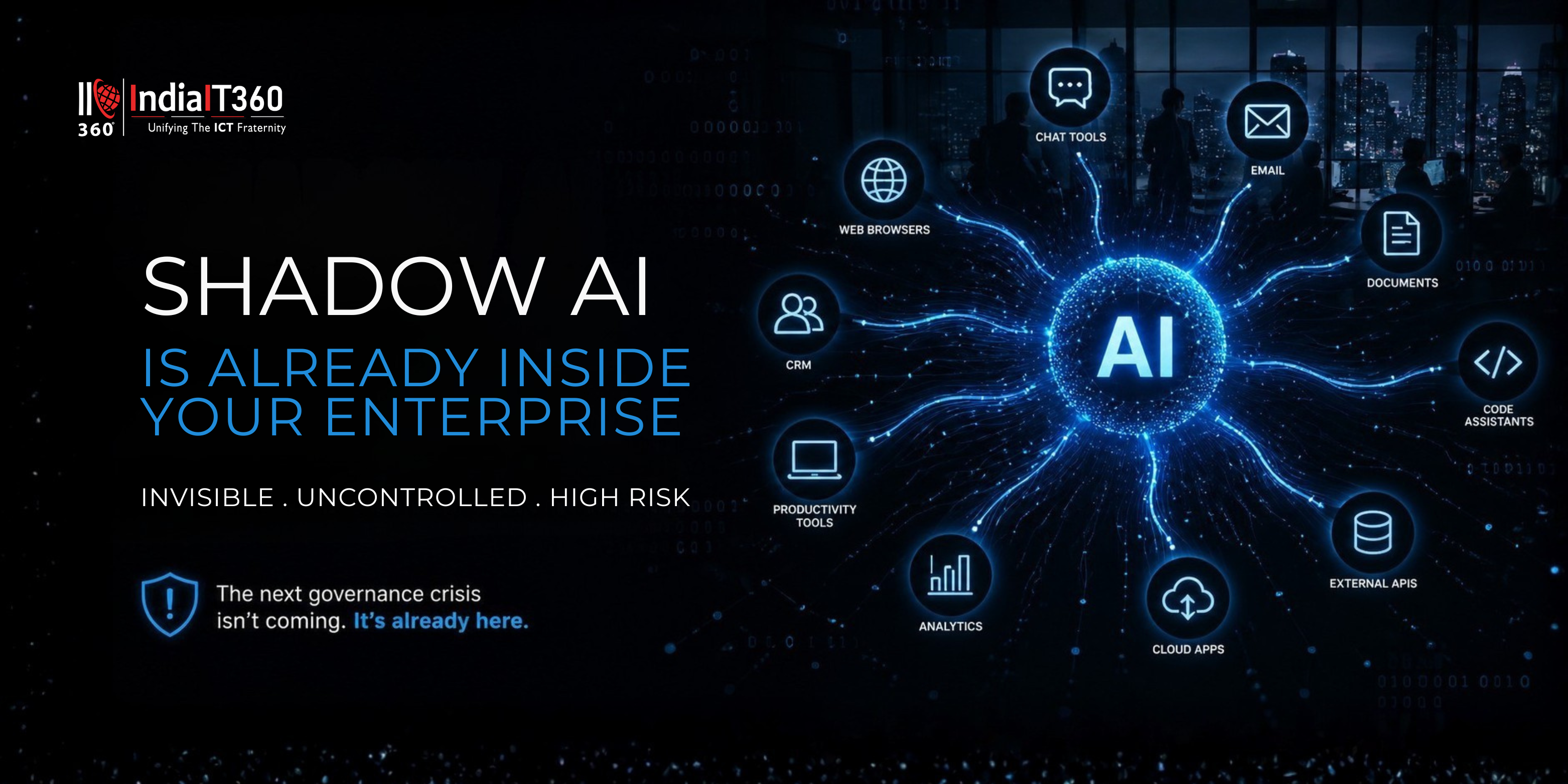
In boardrooms across India, a familiar worry is making a comeback, but this time it’s more complicated. Not too long ago, CIOs were anxious about employees using unauthorized SaaS tools, a phenomenon we referred to as Shadow IT. Fast forward to today, and that concern has transformed into something much more potent, elusive, and potentially hazardous: Shadow AI.
As companies ramp up their AI adoption, an unofficial, unsanctioned ecosystem is quietly emerging. Employees are increasingly turning to generative AI risk tools outside the official IT guidelines, often with the best of intentions, but the risks are significant. What makes Shadow AI particularly concerning isn’t just its widespread use, but also its advanced capabilities.
What is Shadow AI and Why is it Different?
Shadow AI is all about using artificial intelligence tools, models, and platforms without getting the green light from the organization. It’s a step beyond traditional Shadow IT, which was mainly about using unauthorized apps or cloud services. With Shadow AI, we’re talking about giving systems the power to make decisions on their own.
This isn’t just about having a tool at your disposal; it’s about handing over the reins of thinking, processing, and even taking action to systems that IT teams don’t keep an eye on or have control over.
Insights from IBM and various industry analyses reveal that while almost 90% of organizations are pouring resources into AI literacy, a surprising 63% still don’t have formal AI governance policies in place. This is the sweet spot where Shadow AI really takes off.
Why Shadow AI is a Bigger Threat than Shadow IT
-
Permanent Data Exposure: Unlike traditional SaaS tools, generative AI risk systems can keep prompts or use them to enhance future models. This means that once sensitive company data is entered, it could potentially escape the enterprise for good.
-
Invisible Adoption: Shadow AI often doesn’t appear as a distinct tool. It’s woven into browsers, CRMs, email platforms, and productivity suites. Employees might not even realize they’re sidestepping governance protocols.
-
Rise of Shadow Operations: With the advent of agentic AI, tools can now perform tasks like drafting contracts, triggering workflows, or interacting with systems. These autonomous agents can have real-world impacts without needing human approval.
-
Financial Fallout: Research from Palo Alto Networks indicates that organizations exposed to high levels of Shadow AI face an average increase of up to $670,000 per breach.
-
Decentralized Decision-Making: Nowadays, employees have a hand in nearly 85% of SaaS spending, often buying tools on their own. AI tools, many of which are freemium or low-cost, are even simpler to adopt without any oversight.
The Real Risks of Unmanaged AI
-
Data Leakage and IP Theft: Employees are inadvertently sharing sensitive information, from source code to financial models, with public AI tools. This not only risks losing intellectual property but also puts companies at a competitive disadvantage.
-
Regulatory Non-Compliance: As regulations become stricter worldwide, especially with India’s Digital Personal Data Protection Act (DPDP Act) now in effect, using AI without proper oversight could result in significant compliance issues and hefty fines.
-
Hallucinations and Decision Risks: AI models can sometimes produce inaccurate or misleading information. If these outputs aren’t carefully checked, they can lead to poor strategic choices, miscommunication with customers, and issues in compliance reporting.
-
Model Poisoning: Using unverified or compromised AI tools can result in biased or manipulated outputs, which can skew business insights and lead to misguided decisions.
The Indian Context: High Growth, Higher Risk
India is experiencing a remarkable surge in AI adoption across various sectors such as BFSI, healthcare, IT services, and manufacturing. Thanks to initiatives like Digital India and a growing trend towards enterprise digitization, AI has become a necessity rather than a luxury.
Yet, Indian businesses are also grappling with some distinct challenges:
-
Rapid digitization is outpacing the development of governance frameworks
-
A heavy reliance on third-party SaaS solutions and global AI tools
-
An innovation culture driven by the workforce, where employees are encouraged to experiment on their own
This situation creates a perfect storm: a fast-paced innovation environment coupled with limited control mechanisms.
Why Banning AI Will Not Work
Some organizations have taken the drastic step of completely blocking AI tools. However, this kind of approach is really short-sighted.
History has shown us that strict restrictions only drive usage underground, making what’s known as Shadow AI even trickier to spot. Employees will always find ways to use AI, especially when it can significantly enhance their productivity.
The answer isn’t to ban it; it’s to enable its use while implementing proper governance.
From Reactive to Proactive: Building an AI Governance Framework
1. Visibility Comes First: To effectively manage AI, organizations need to first get a clear picture of where and how it's being utilized. Tools like Cloud Access Security Brokers (CASB) and Data Loss Prevention (DLP) can be invaluable in uncovering Shadow AI activities.
2. Shift to Data-Centric Governance: Rather than just concentrating on the tools themselves, businesses should prioritize the flow of data:
-
What data is being shared?
-
Who is sharing it?
-
Where is it headed?
3. Provide Approved Alternatives: When employees turn to public AI tools, it often signals a gap in internal offerings. Companies should provide secure, enterprise-level AI platforms that are not only user-friendly but also superior to public options.
4. Create an AI Agent Registry; As autonomous agents become more prevalent, organizations should keep a registry of all AI entities operating in their ecosystem, monitoring their roles, permissions, and activities.
5. Continuous AI Literacy and Policy Evolution: AI governance isn't a one-and-done deal. It demands ongoing training, adaptable policies, and collaboration across IT, legal, HR, and business teams to stay effective.
The Road Ahead
Shadow AI isn’t just a fleeting trend; it represents a fundamental change in how we approach work. Similar to the rise of Shadow IT a decade ago, it indicates a significant transformation. Now, technology adoption is driven by employees rather than just the IT department.
For businesses in India, the potential is huge, but so are the risks.
The organizations that will thrive are those that don’t shy away from AI but instead manage it wisely, finding the right balance between innovation and control, speed and security, as well as autonomy and accountability.
In this AI-driven era, what you can’t see might just be the biggest threat

 Team IndiaIT360

eBook
Tech Titans Speak


















Poll of the Week
Which VDI platform do you currently use or prefer using?
What is driving your organization to reconsider its VDI strategy today?
What would help you grow your business faster as a channel partner?
How ready is your payments ecosystem for AI-driven automation?
What matters most in your cloud journey?
What's your biggest IT headache?
How do you prefer to stay updated on emerging tech trends?
Which breakthrough technology would most elevate your endpoint security?

Ad

Ad
Teaser of the Week