APP


From India to the World: How AI Startups Are Expanding Globally From Home Ground
-
 Parul Bhati
- 09-Jun-2026
- 61 Views
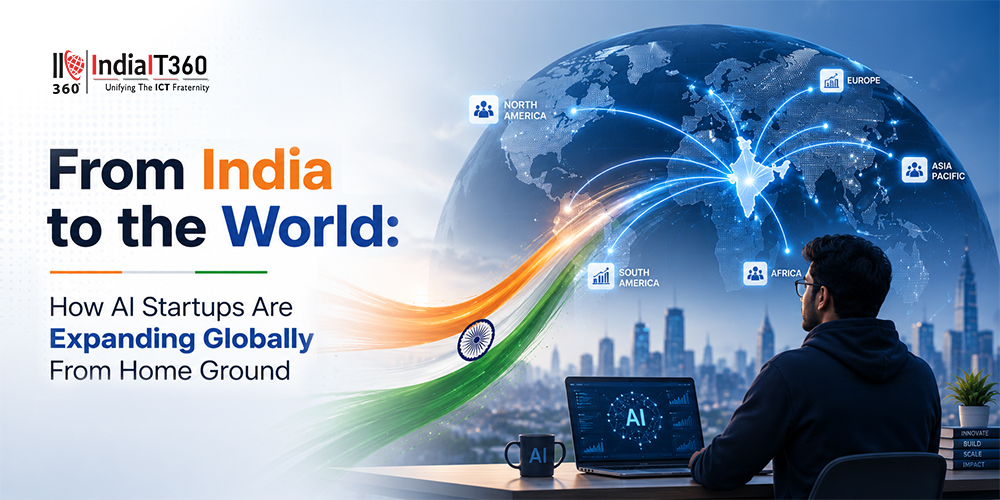
There’s a quiet but unmistakable shift happening in the corridors of India’s tech hubs. From the bustling boardrooms of Bengaluru to the rising innovation pockets of Delhi-NCR, a specific pattern is emerging. Founders who built their initial models on home soil are packed, ready, and catching flights to San Francisco, New York, and Austin.
The conversation has evolved beyond just finding a bigger market. Today, AI startups moving to the US is one of the defining trends reshaping the Indian startup ecosystem. But it begs a critical question: In an era where India is hailed as a global digital powerhouse, why are Indian founders going global so early in their lifecycle?
Let’s unpack what is truly driving this migration, the hard realities on the ground, and why it isn’t a loss for India but rather the birth of a powerful cross-border dynamic.
The Pull of Silicon Valley: Compute, Capital, and Customers
Building a traditional software-as-a-service (SaaS) company is vastly different from scaling an Artificial Intelligence company. AI demands two things in massive quantities: specialised compute power (GPUs) and deep pockets.
While India has no shortage of engineering brilliance, something we witnessed firsthand at the AI Impact Summit 2026: A Moment That Quietly Changed the Direction of AI in India, the infrastructure and funding landscape for foundational AI models is still maturing.
For an AI founder, being physically present in Silicon Valley means proximity to:
-
Venture Capital at Scale: US-based venture capital firms are uniquely positioned to write the massive checks required for AI R&D, often investing heavily in pure vision and early-stage algorithmic breakthroughs.
-
The Compute Ecosystem: Early access to cutting-edge cloud infrastructure and hardware partnerships happens faster when you are in the local ecosystem.
-
Enterprise Enterprise Clients: For B2B AI startups, the enterprise software market in the US remains the largest and most willing to adopt unproven, cutting-edge AI tools.
Navigating the "Flip" Structure
To capture this American capital and enterprise market, many young companies undergo what the industry calls a flip structure in Indian startups. This legal restructuring moves the parent holding company to the US (often Delaware), turning the original Indian entity into a wholly-owned subsidiary focused on engineering and product development.
Historically, regular tech startups flipped for tax benefits or smoother exit paths. For AI startups, flipping has become a functional necessity to easily integrate with global cloud providers, clear international regulatory baselines, and attract specialized global talent.
The Bridge: Fostering Cross-Border Tech Collaboration
This geographical shift doesn't mean India loses its competitive edge. Instead, it is giving rise to a highly efficient hybrid model. Founders are establishing their customer-facing fronts and corporate headquarters in the US, while keeping their core research, data processing, and heavy engineering talent firmly rooted in India.
The industry recognizes that for these ambitious teams to succeed, they need a frictionless gateway that connects Indian innovation with American scale. A stellar example of this enabling infrastructure is the IndiaIT360 global expansion and strategic partnership with NMEXUS Centre in the US. By actively lowering the barriers for cross-border tech collaboration, initiatives like these ensure that when tech founders decide on global expansion, they aren't starting from scratch. They enter the North American market with a robust network of enterprise connections, compliance support, and localized market insights already intact.
A New Chapter for Indian Tech
We should stop viewing the migration of AI founders as a brain drain. The reality of modern technology is borderless. The founders heading west today are building global institutions that will ultimately funnel capital, knowledge, and prestige right back into our ecosystem.
By securing access to global compute and capital, India's AI pioneers aren't leaving the country behind; they are merely expanding its footprint on the global stage.
What's Your Take?
Are you an AI founder considering a cross-border move, or an enterprise leader observing this shift? Let’s talk about how we can build stronger bridges between Indian talent and global markets in the comments below!


 Parul Bhati

eBook
Tech Titans Speak


















Poll of the Week
Which VDI platform do you currently use or prefer using?
What is driving your organization to reconsider its VDI strategy today?
What would help you grow your business faster as a channel partner?
How ready is your payments ecosystem for AI-driven automation?
What matters most in your cloud journey?
What's your biggest IT headache?
How do you prefer to stay updated on emerging tech trends?
Which breakthrough technology would most elevate your endpoint security?

Ad
Teaser of the Week