APP


The Hidden Carbon Cost of Technology: What Enterprises Can No Longer Afford to Ignore
-
 Parul Bhati
- 04-Jun-2026
- 38 Views
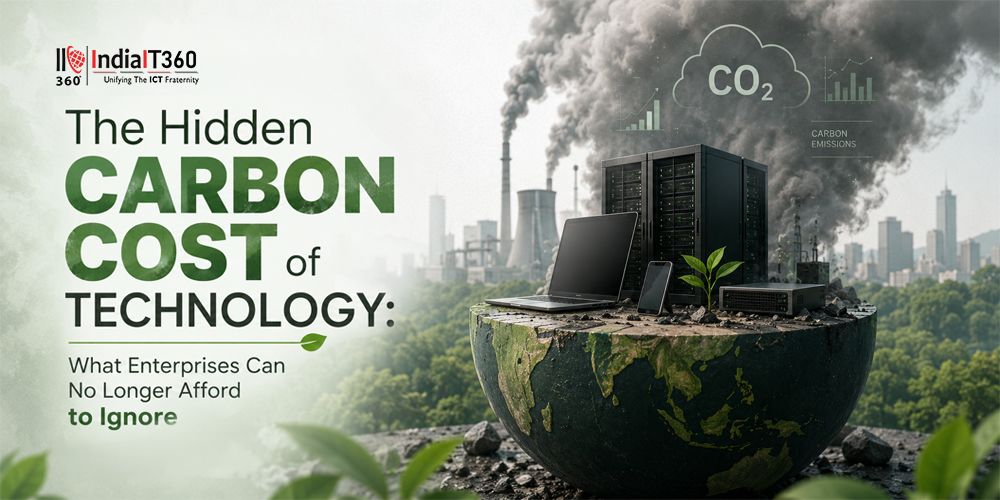
Technology has become the backbone of modern business. Every customer interaction, financial transaction, video meeting, cloud application, and AI-driven process relies on a vast digital ecosystem operating behind the scenes. While organisations often celebrate the efficiency, speed, and innovation delivered by technology, a critical question is gaining urgency.
What is the environmental cost of our digital future?
For years, sustainability discussions have focused on transportation, manufacturing, and energy production. Yet technology, often perceived as a clean industry, carries a significant and frequently overlooked carbon footprint of technology. From sprawling data centres and cloud infrastructure to AI workloads and connected devices, the digital economy consumes enormous amounts of energy and resources.
As enterprises accelerate digital transformation, understanding the hidden carbon cost of technology is no longer just an environmental concern. It is becoming a business imperative.
The Invisible Infrastructure Behind Every Click
The digital world feels weightless. Emails replace paper, cloud platforms eliminate physical servers from office premises, and virtual meetings reduce travel. These benefits are real, but they often obscure the infrastructure required to keep digital services running.
Every search query, file upload, video stream, and AI prompt triggers activity across servers, networks, storage systems, and cooling equipment housed in data centres around the world.
According to the International Energy Agency, data centres consumed approximately 415 terawatt-hours of electricity in 2024, accounting for about 1.5 per cent of global electricity consumption. The agency projects that this demand could more than double to nearly 945 terawatt-hours by 2030, driven largely by artificial intelligence and expanding digital services.
What appears as a simple digital interaction often depends on an energy-intensive infrastructure operating continuously, 24 hours a day.
The Carbon Footprint Extends Beyond Data Centres
When discussing carbon emissions in IT, data centres typically dominate the conversation. However, the carbon footprint of technology extends across an entire lifecycle.
Raw materials must be extracted to manufacture smartphones, laptops, servers, networking equipment, and semiconductors. Global supply chains transport these products across continents. Devices consume electricity throughout their operational life. Eventually, they contribute to the growing challenge of electronic waste.
Research published in Telecommunications Policy estimates that the ICT sector accounted for approximately 1.4 per cent of global greenhouse gas emissions in 2020. Notably, user devices accounted for the largest share of those emissions, underscoring that IT sustainability challenges extend far beyond enterprise infrastructure.
For businesses pursuing sustainable technology goals, focusing solely on operational energy consumption provides only part of the picture.
Artificial Intelligence Is Reshaping the Sustainability Equation
Artificial intelligence is transforming enterprise operations at an unprecedented pace. From customer service automation and predictive analytics to software development and cybersecurity, AI is becoming deeply embedded across industries.
However, AI energy consumption and its environmental impact deserve closer attention.
Training and operating advanced AI models require specialised computing infrastructure powered by high-performance processors. These systems consume substantially more electricity than traditional computing workloads.
Industry estimates suggest AI could become one of the largest contributors to future data centre emissions. Analysts project that AI-related workloads may account for a significant share of data centre power consumption as adoption continues to accelerate.
This does not mean AI should be viewed as environmentally harmful by default. AI also has the potential to improve energy efficiency, optimise logistics, reduce waste, and support climate initiatives. The challenge lies in ensuring that the benefits outweigh the environmental costs.
The Cloud Is Not Carbon-Free
Cloud computing is frequently positioned as a sustainability enabler. In many cases, hyperscale cloud providers operate more efficiently than traditional enterprise data centres.
However, moving workloads to the cloud does not eliminate emissions. It shifts them.
Organisations often lose visibility into the energy consumption associated with cloud computing operations. As businesses increase storage volumes, run complex analytics, and expand AI deployments, cloud-related energy demand rises accordingly.
The perception that cloud services are inherently green can create a dangerous blind spot. Sustainable cloud adoption requires active monitoring, workload optimisation, and collaboration with providers that demonstrate measurable progress toward renewable energy adoption and carbon reduction.
Understanding the carbon footprint of cloud computing is becoming essential for organisations committed to digital sustainability.
The Growing Importance of Scope 3 Emissions
One of the most overlooked aspects of technology and climate change is Scope 3 emissions.
These emissions originate across a company's value chain, including purchased hardware, supplier operations, transportation, manufacturing, and end-of-life disposal.
For many technology organisations, Scope 3 emissions account for the majority of their total carbon footprint. This reality is forcing business leaders, procurement teams, and sustainability professionals to rethink sourcing strategies and supplier relationships.
Environmental accountability is increasingly moving beyond direct operations toward the broader technology ecosystem.
The question is no longer whether a company uses renewable energy. Stakeholders now want to understand the environmental impact of every digital asset supporting business operations.
Sustainability Is Becoming a Boardroom Metric
Technology sustainability has evolved from a corporate social responsibility initiative into a strategic business issue.
Investors, regulators, customers, and employees increasingly expect organisations to demonstrate measurable progress toward environmental goals. ESG reporting requirements continue to expand across global markets, placing greater scrutiny on technology-related emissions.
For business leaders, sustainability is becoming intertwined with risk management, operational efficiency, brand reputation, and long-term competitiveness.
Organisations that can accurately measure, manage, and reduce their digital carbon footprint will be better positioned to meet future regulatory expectations and stakeholder demands.
What Enterprises Should Do Next
Addressing the hidden carbon cost of technology requires more than sustainability pledges.
Organisations should begin by establishing visibility across their digital infrastructure. Carbon measurement tools, energy monitoring platforms, and sustainability dashboards can help identify high-impact areas.
Business and technology teams should evaluate:
-
Data centre efficiency and energy sourcing
-
Cloud workload optimization
-
Responsible AI deployment strategies
-
Sustainable hardware procurement
-
Device lifecycle management
-
Supplier sustainability performance
-
Carbon reporting and governance frameworks
The goal is not to slow innovation. It is to ensure innovation progresses responsibly.
The Road Ahead
Technology will remain central to economic growth, digital transformation, and business innovation. Yet every technological advancement carries an environmental footprint that can no longer be ignored.
The hidden carbon cost of technology is not simply a sustainability challenge. It is a leadership challenge.
The enterprises that thrive in the coming decade will be those that recognise sustainable technology as a core component of business strategy rather than an afterthought. As digital infrastructure expands and artificial intelligence reshapes industries, responsible innovation will become the defining characteristic of future-ready organisations.
The future of technology should not be measured solely by processing power, connectivity, or automation. It should also be measured by how efficiently and responsibly those capabilities are delivered.


 Team IndiaIT360

eBook
Tech Titans Speak



































Poll of the Week
Which VDI platform do you currently use or prefer using?
What is driving your organization to reconsider its VDI strategy today?
What would help you grow your business faster as a channel partner?
How ready is your payments ecosystem for AI-driven automation?
What matters most in your cloud journey?
What's your biggest IT headache?
How do you prefer to stay updated on emerging tech trends?
Which breakthrough technology would most elevate your endpoint security?

Ad
Teaser of the Week