Ad


From Cloud-Native to Edge-Native: Re-Architecting for India's Physical World
-
 Team IndiaIT360
- 03-Feb-2026
- 1555 Views

India's digital transformation story has progressed at remarkable speed. What began with cloud-first modernization has now entered a new, more distributed phase, one in which artificial intelligence (AI) and edge computing combine to deliver real-time, contextual intelligence across industries. For India's digital-native businesses, this evolution from cloud-native architectures toward edge-native systems represents both a strategic necessity and a competitive advantage.
India's digital ecosystem has matured rapidly over the last decade. Cloud-native architectures enabled speed, scale, and global reach, allowing digital-native companies to build platforms that serve millions of users with agility. Today, however, a new architectural shift is underway. As applications demand real-time intelligence, contextual awareness, and ultra-low latency, cloud-only models are giving way to edge-native design.
Rather than replacing the cloud, edge-native design encompasses it. The cloud gradually serves as the control plane for training models, orchestration, and centralized data management, while the edge serves the compute plane, enabling local inference and real-time action closer to users, devices, and operating environments.
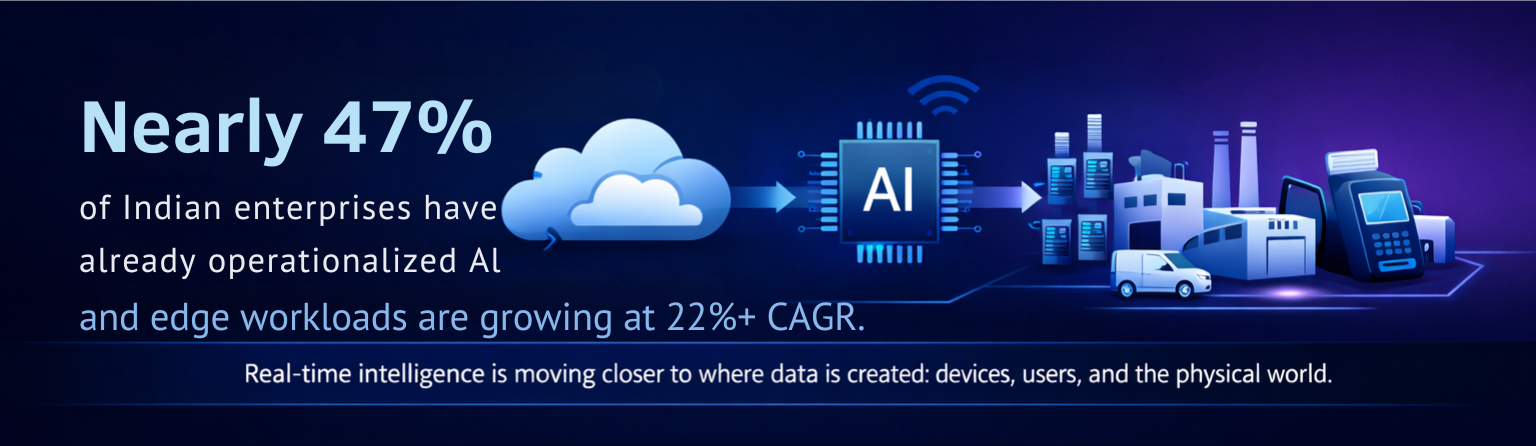
This transition reflects a broader reality: value is increasingly created at the point where data is generated. Intelligence must move closer to users, applications, and physical endpoints, from smart logistics and quick commerce execution to offline-first UPI payment systems and Industry 4.0 manufacturing environments. Edge-native architectures, powered by Edge AI, are becoming foundational to the next phase of digital and physical convergence.
Source: Industry reports (NASSCOM, IDC, Gartner)
Why Edge-Native Architectures Are Gaining Momentum in India
India's rapid adoption of AI-driven platforms has created ideal conditions for edge-native systems to scale. Digital-native companies are increasingly embedding intelligence into distributed environments to meet growing expectations for responsiveness and resilience, while physical-world businesses are using edge computing to power last-mile delivery optimization, real-time quality checks, and localized payment processing in low-connectivity regions.
Industry data indicates that nearly half of Indian enterprises have already operationalized AI in production environments, with adoption accelerating as real-time analytics and automation become standard expectations. At the same time, the Indian edge computing market is projected to grow at a compound annual rate of over 22% through 2030, driven largely by AI workloads and distributed application models.

Edge AI as a Growth Enabler for Digital-Native Businesses
Edge AI fundamentally changes how digital platforms operate. Instead of routing every interaction back to centralized infrastructure, distributed inference allows decision-making to happen locally, reducing latency, improving reliability, and enabling real-time adaptability.
For digital-native organizations operating in both digital and physical environments, this translates into measurable outcomes:
- Faster application response times, improving user experience across geographies
- Local observability, enabling on-device detection of anomalies and performance issues without continuously shipping telemetry to central systems
- Optimized Al operations through distributed inference and model optimization (such as quantization), reducing cloud dependency while improving efficiency on resource-constrained edge devices.
- Stronger data governance, with sensitive information processed closer to its source
These capabilities are increasingly critical as platforms scale globally while needing to behave locally, adapting instantly to usage patterns, network conditions, and contextual signals across stores, warehouses, factories, and mobile endpoints.
Re-Architecting for Distributed Intelligence
Becoming edge-native requires more than deploying compute at the edge. It demands a rethinking of how applications are designed, deployed, and managed:
- Distributed application models that operate seamlessly across cloud and edge environments
- AI-optimized pipelines that balance performance, cost, and energy efficiency across centralized training and edge-based inference
- Intelligent data orchestration, ensuring insights are generated where they are most valuable, whether on factory floors or delivery routes
- Unified governance and security, maintaining consistency across a highly distributed landscape
Leading digital organizations are already adopting these principles, enabling platforms that are not only scalable but also context-aware and resilient by design.
India's Advantage in the Edge-Native Shift
India's digital ecosystem brings a unique advantage to this transition. A strong talent base, a mature services and platform landscape, and increasing investment in AI infrastructure position Indian companies to lead in edge-native innovation across sectors such as manufacturing, retail, fintech, and logistics.
Global enterprises are increasingly looking to India not just as a delivery hub but as a centre for architecture, engineering, and platform innovation, particularly in distributed and AI-driven systems that bridge software intelligence with real-world operations.
The Way Forward
The evolution from cloud-native to edge-native architecture marks a defining moment for India's digital economy. By embedding intelligence into the physical world and bringing AI closer to users, devices, and operational environments, organizations can uncover real-time responsiveness, operational efficiency, and a differentiated digital experience.
Edge AI is no longer an emerging concept; it is becoming a core architectural foundation for platforms designed to scale across India’s connected, real-world landscapes.
Written and approved by Mr. Mangesh Gothankar, CTO, Signity Software Solutions Pvt. Ltd.


 Suraj Kumar

eBook
Tech Titans Speak


























Poll of the Week
What is driving your organization to reconsider its VDI strategy today?
What would help you grow your business faster as a channel partner?
How ready is your payments ecosystem for AI-driven automation?
What matters most in your cloud journey?
What's your biggest IT headache?
How do you prefer to stay updated on emerging tech trends?
Which breakthrough technology would most elevate your endpoint security?

Ad

Ad
Teaser of the Week