APP


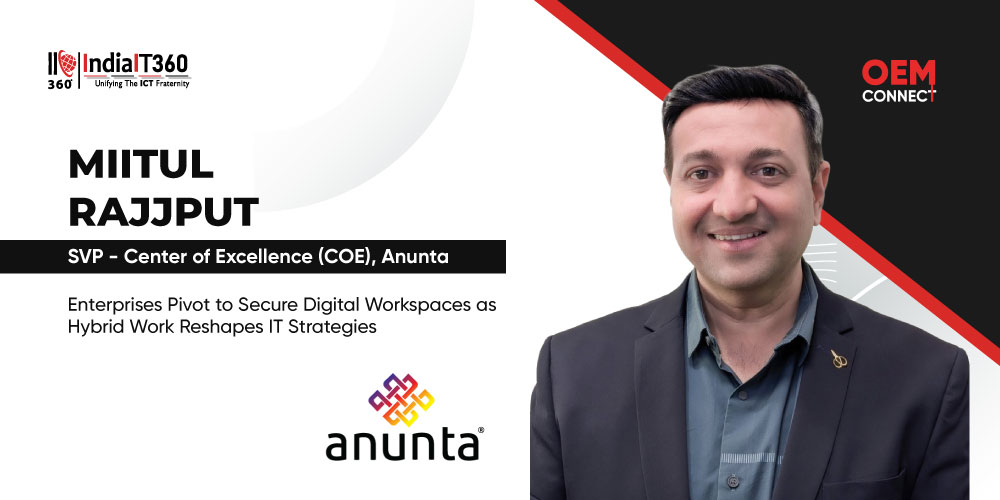
Enterprises Pivot to Secure Digital Workspaces as Hybrid Work Reshapes IT Strategies
-
 Team IndiaIT360
- 14-Mar-2026
- 2992 Views
Hybrid Work Reshapes IT Strategies
The enterprise workplace is no longer defined by a physical office or a corporate network. Over the past few years, organizations have moved from emergency remote work setups to sustainable hybrid models where employees expect seamless access to applications and data from virtually anywhere.
This shift is forcing IT leaders to rethink how digital workspaces are designed, secured, and managed.
Miitul Rajjput, Senior Vice President of the Center of Excellence at Anunta, believes the conversation has moved well beyond remote access.
"What began as a temporary response during the pandemic has evolved into a structural transformation of how work happens," Rajjput explains. "Employees today operate across offices, homes, branches, and mobile environments. The enterprise workspace must therefore be consistent, secure, and compliant regardless of where the user connects from."
For CIOs and IT leaders, the focus is no longer just enabling connectivity. It is about building resilient digital workspace platforms that deliver enterprise-grade security, performance, and governance in a distributed work environment.

Advertisement
Why Legacy Endpoint-Centric IT Is Reaching Its Limits
Traditional enterprise IT architectures were designed around a clear perimeter. Applications ran inside corporate data centers, devices were standardized, and access happened largely from within office networks.
Hybrid work has dismantled that model.
Employees now access enterprise applications through a mix of corporate devices, personal devices, home networks, and public internet connections. As a result, the endpoint has effectively become the new perimeter.
This dramatically expands the enterprise attack surface.
Security teams must now manage risks ranging from device compromise and malware infiltration to inconsistent policy enforcement across thousands of distributed endpoints.
"Managing applications and operating systems directly on individual devices no longer scales in a hybrid work environment," Rajjput notes. "The complexity and risk increase exponentially when every endpoint becomes a potential security gateway."
As organizations scale distributed workforces, IT leaders are increasingly shifting toward centralized digital workspace architectures.
Centralized Digital Workspaces: A Strategic Shift
Virtual desktop infrastructure and Desktop-as-a-Service platforms are gaining renewed momentum as enterprises seek to centralize control over applications, desktops, and data.
Solutions such as Omnissa Horizon allow organizations to host desktops and applications centrally while delivering them securely to users on any device.
This fundamentally changes how workspaces are managed.
Instead of maintaining thousands of endpoints individually, IT teams manage desktop images, applications, policies, and updates from a centralized platform. This not only simplifies operations but also strengthens security by keeping enterprise data within controlled infrastructure environments.
"When desktops and applications are delivered from centralized infrastructure, organizations regain control over security, access policies, and compliance," Rajjput says. "Data stays in the data center or cloud environment, not on potentially vulnerable devices."
Equally important, centralized digital workspaces align naturally with Zero Trust security models. Access decisions can incorporate user identity, device posture, network conditions, and contextual risk signals before granting access to enterprise resources.

Navigating Hybrid Infrastructure Realities
Most enterprises today operate across a combination of private data centers, public cloud platforms, and hybrid environments.
Regulatory requirements, latency considerations, and cost structures often dictate where workloads must reside. Financial services and healthcare organizations, for example, may need to maintain sensitive workloads in private infrastructure while leveraging public cloud platforms for elasticity.
Modern digital workspace platforms are designed to operate across these hybrid infrastructures.
Desktops can be deployed in private environments for regulated workloads while leveraging public cloud capacity for seasonal demand, remote workforce expansion, or disaster recovery.
Anunta plays a critical role in designing and managing these architectures for global enterprises.
Through its enterprise DaaS and VDI services, the company enables organizations to build digital workspaces that span on-premises infrastructure, private cloud environments, and hyperscale cloud platforms while maintaining consistent performance and security.
In one recent engagement, Anunta enabled a healthcare business process management provider to scale more than 1,500 secure virtual desktops to support remote operations while maintaining strict compliance requirements. In another instance, the company modernized digital workspace infrastructure for a leading cooperative bank, strengthening both operational efficiency and security governance.
The Often Overlooked Challenge: User Experience
While security and scalability are essential, user experience ultimately determines the success of any digital workspace initiative.
If virtual desktops feel slower or less responsive than physical devices, employee productivity suffers, and adoption falters.
Advancements in display protocols such as Blast Extreme, GPU acceleration, and network optimization have significantly improved virtual desktop performance. However, delivering a consistently high-quality user experience still requires careful infrastructure design and continuous monitoring.
Anunta’s managed digital workspace services address this challenge through proactive performance analytics, workload optimization, and capacity planning.
By analyzing user workloads and application behavior in real time, the company helps organizations right-size resources, maintain performance consistency, and ensure that even graphics-intensive workloads perform reliably in virtual environments.
Why Day-2 Operations Determine Long-Term Success
Many organizations invest heavily in deploying virtual desktop infrastructure, but underestimate the complexity of operating it at scale.
Digital workspace environments are dynamic. User workloads evolve, applications are updated, infrastructure must be patched, and performance requirements shift continuously.
Without disciplined operational management, these environments can quickly become inefficient or unstable.
"Implementation is only the beginning," Rajjput emphasizes. "A crucial challenge is to maintain performance, security, and efficiency over time."
Anunta focuses heavily on Day-2 operations through its managed services model.
Key operational capabilities include:
- Continuous 24x7 monitoring and proactive incident detection
- Performance and capacity optimization to avoid infrastructure sprawl
- Automated patching and upgrade cycles
- Root cause analysis and rapid incident resolution
- Continuous end-user experience optimization
Through these operational frameworks, Anunta has helped enterprises maintain resilient digital workspace environments across sectors, including manufacturing, financial services, energy, and healthcare.
In one large-scale engagement, the company enabled a global energy and utilities organization to modernize its digital workplace infrastructure while achieving substantial operational efficiencies and improving workforce productivity.
The Road Ahead for Digital Workspaces
Hybrid work is no longer an experiment. It is becoming a permanent feature of enterprise operating models.
As regulatory pressures increase and cyber threats continue to evolve, digital workspace platforms will play an increasingly central role in enterprise security and workforce productivity strategies.
Technologies such as Zero Trust access models, AI-driven operational analytics, and intelligent automation will further transform how digital workspaces are delivered and managed.
"Organizations are recognizing that secure digital workspaces are not just an IT initiative," Rajjput concludes. "They are a foundational element of modern enterprise operations."
For CIOs navigating distributed work environments, the ability to deliver secure, high-performance digital workspaces will increasingly determine how effectively organizations can enable productivity while protecting critical enterprise assets.
About Anunta
Anunta helps enterprises build secure, scalable digital workspaces across private, public, and hybrid cloud environments. The company’s portfolio includes enterprise Desktop-as-a-Service, VDI migration services, managed endpoint services, and cloud infrastructure management.
Through its AI-driven operational platforms and deep expertise in digital workspace environments, Anunta enables organizations to deliver consistent, secure access to enterprise applications while improving operational efficiency and user experience.
With more than a decade of experience and over one million virtual desktops migrated globally, Anunta continues to support enterprises in transforming their workplace infrastructure for the demands of a distributed workforce.
Approved by Mr. Miitul Rajjput, SVP - Center of Excellence (COE) at Anunta


 Team IndiaIT360

eBook
Tech Titans Speak























Poll of the Week
What’s your biggest challenge in scaling your SaaS platform?
Which VDI platform do you currently use or prefer using?
What is driving your organization to reconsider its VDI strategy today?
What would help you grow your business faster as a channel partner?
How ready is your payments ecosystem for AI-driven automation?
What matters most in your cloud journey?
What's your biggest IT headache?
How do you prefer to stay updated on emerging tech trends?
Which breakthrough technology would most elevate your endpoint security?

Ad
Teaser of the Week