Leaders Tech Talk: Artificial Intelligence: Transforming the Future


Ad


Is India’s Tech Leadership Ready for the Next Wave of Enterprise Complexity?
-
 Team IndiaIT360
- 22-Aug-2026
- 30 Views
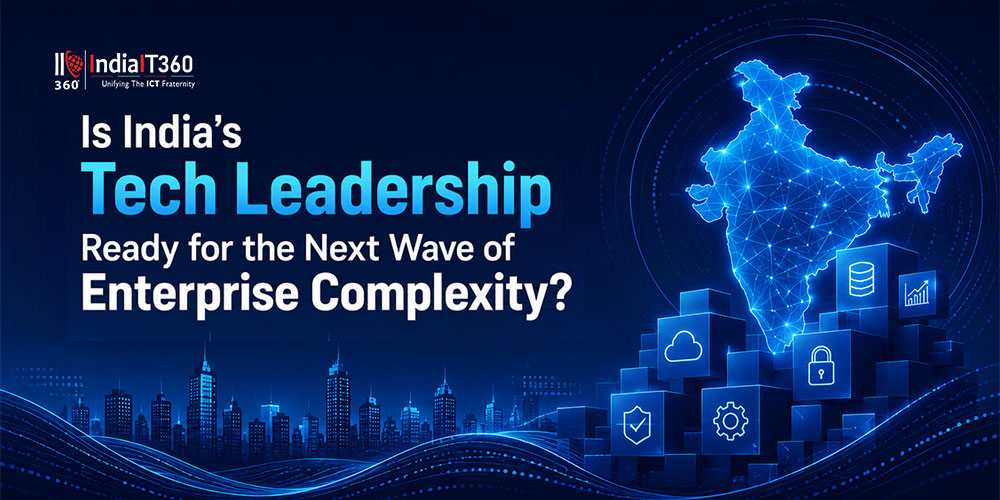
What happens when technology moves faster than the organisation built to manage it?
For India's CIOs, CTOs, and CISOs, this is no longer a theoretical question. They are being asked to modernise legacy systems, secure increasingly distributed environments, make sense of growing volumes of data, and adopt new technologies and still demonstrate business value, often without a proportionate increase in budgets or skilled talent.
The pressure is coming from every direction. Cyber threats are becoming more persistent, cloud environments are becoming more complex, AI in enterprises is increasing infrastructure requirements, and business teams expect technology to deliver faster outcomes. At the same time, the technology estate that sits underneath many large Indian organisations was not designed for this level of speed or complexity.
The result is a difficult balancing act: how can technology leaders modernise the enterprise without increasing cost, risk, and operational disruption?
There is no single answer. But the emerging Indian enterprise landscape offers some clear directions.
The Security Problem Is No Longer Sitting Outside the Business
Cybersecurity in India used to be treated primarily as an IT function. Today, it is a business continuity issue.
India's threat landscape continues to evolve, with ransomware, data breaches, malware, credential attacks, and exploitation of vulnerabilities affecting organisations across sectors. In May 2025, CERT-In warned of a surge in ransomware, DDoS attacks, website defacement, data breaches, and malware infections. More recently, CERT-In has continued to issue advisories around targeted vulnerabilities and active campaigns, including attacks against enterprise security infrastructure and malware distributed through WhatsApp attachments.
For CISOs in India, the challenge is not simply detecting an attack. It is maintaining visibility across endpoints, identities, cloud workloads, applications, networks, and data while ensuring that security controls do not become another layer of complexity.
The response, therefore, has to move towards cyber resilience rather than security in isolation. Automated detection, stronger identity controls, continuous monitoring, threat intelligence, and faster incident response can help security teams move from reacting to incidents towards anticipating and containing them.
India's security spending reflects the urgency. Gartner forecasts that information security spending in India will reach $3.4 billion in 2026, up 11.7% from 2025. The growth is being driven by increasingly sophisticated threats, identity risks, and regulatory requirements.
The question for technology leaders is no longer whether to invest in security. It is where those investments can create the greatest reduction in risk.
Can Legacy Infrastructure Keep Pace With a Digital Business?
There is another problem that rarely makes the headlines but quietly consumes technology budgets: legacy IT systems.
For many enterprises, replacing an old application is not as simple as switching it off and deploying something new. Legacy systems may be deeply connected to business processes, customer records, financial systems, and operational workflows. They may be difficult to replace because nobody wants to disrupt a system that still works, even if it is expensive to maintain.
This creates a familiar dilemma for enterprise CIOs. Modernise too quickly, and the business may face disruption. Modernise too slowly, and the organisation risks becoming increasingly dependent on infrastructure that limits innovation.
The answer is not always a complete replacement.
A more practical IT modernisation strategy can involve prioritising systems based on business value, moving suitable workloads to the cloud computing ecosystem in India, modernising applications in phases, and retaining systems where replacement does not make economic sense.
India's cloud market shows how quickly this transition is accelerating. Gartner expects public cloud spending in India to reach $17.5 billion in 2026, a 28.1% increase over 2025. Infrastructure as a Service is forecast to grow by 40%, while Platform as a Service is expected to grow by 25.4%.
But moving to the cloud is not the destination. The bigger challenge is managing cloud environments intelligently.
More Cloud Does Not Automatically Mean Better Technology
As cloud adoption in India accelerates, another pressure is emerging: cost and complexity.
Indian enterprises are now operating across hybrid and multicloud environments, SaaS platforms, data platforms, and increasingly compute-intensive workloads. Add enterprise AI infrastructure to this mix, and the technology bill can become difficult to predict.
This is where FinOps and cloud cost optimisation are becoming increasingly relevant to CIOs.
The answer is not simply to cut cloud spending. It is to understand where technology spending creates business value and where it does not. Unused licenses, idle resources, duplicate applications, and poorly placed workloads can quietly consume budgets that could otherwise fund innovation.
Gartner's 2026 cloud forecast points to exactly this transition, noting that organisations need stronger governance, FinOps maturity, security by design, and disciplined workload placement across hybrid and multicloud environments.
For technology leaders, the goal should therefore be simple: spend less where technology adds little value and invest more where it directly improves business outcomes.
The Talent Problem Cannot Be Solved Through Hiring Alone
Technology can be purchased. Skilled people are harder to find.
India's technology sector is experiencing strong demand for AI talent in India, cloud, cybersecurity, data, and engineering skills. The Deloitte-Nasscom research on India's AI skills landscape projected demand for AI talent to grow from around 600,000 to 650,000 professionals in 2022 to more than 1.25 million by 2027.
That gap changes the talent conversation.
For CTOs and CIOs in India, the answer cannot be hiring endlessly for every emerging technology. Organisations need to build an AI-ready workforce by combining selective hiring with reskilling, internal mobility, and practical training.
This is particularly important because the skills required to run a modern enterprise are increasingly interconnected. A cloud architect needs to understand security. A data professional needs to understand governance. A cybersecurity team needs to understand cloud workloads. Business teams need enough technology literacy to use new tools responsibly.
The future workforce will therefore be less about isolated specialists and more about people who can work across technology domains.
What Happens When the Enterprise Has More Data Than It Can Trust?
Data was supposed to make business decisions easier.
Instead, many organisations now have more data sources, dashboards, applications, and databases than their teams can effectively manage.
The problem is no longer access to data. It is knowing which data can be trusted.
As organisations move towards data-driven decision-making in enterprises, data quality, governance, security, and accessibility become critical. This becomes even more important as enterprises deploy AI applications that depend on reliable organisational information.
A poor data strategy in enterprises can produce a technically impressive system that delivers the wrong answer.
That is why a practical data strategy should begin with identifying critical data, establishing ownership, improving quality, removing unnecessary duplication, and creating governance that supports business users without slowing them down.
The objective is not to collect more data.
It is to make the right data usable.
So, What Should Technology Leaders Do Differently?
The answer is not to chase every new technology.
For Indian enterprises, the more sustainable approach is to build a technology roadmap around five priorities: strengthen cyber resilience strategy, modernise infrastructure in phases, bring discipline to cloud cost optimisation, build internal technology capabilities, and establish a trusted data governance framework.
These priorities are closely connected.
Modern infrastructure without security creates risk. Cloud adoption without cost governance creates waste. Data without governance creates confusion. AI without reliable information creates questionable outcomes. Technology without skilled people creates dependency.
The real opportunity for CIOs, CTOs, and CISOs in India lies in bringing these decisions together rather than solving them independently.
That is where peer conversations become valuable.
The Next Technology Advantage May Come From Better Conversations
Technology leaders do not need another list of trends. They need practical conversations about what works, what does not, where investments are delivering value, and how others are navigating similar constraints.
That is the thinking behind Tech Business Connect 2026, IndiaIT360's flagship IT CXO Summit India, taking place on 11–12 September 2026 in New Delhi.
The two-day gathering will bring together 400+ IT CXOs, 80+ business partners, 20+ topical sessions, 15+ executive roundtables, and 1,500+ minutes of meaningful networking, creating a setting where technology challenges can be discussed with the people actually responsible for solving them.
The agenda is closely aligned with the pressures facing today's technology leadership.
AI & The Future of Technology will examine how organisations can move from experimentation towards meaningful adoption and business outcomes. Cloud & Modern Infrastructure will address scalability, modernisation and the realities of hybrid infrastructure. Data Resilience & Trust will focus on building secure, reliable, and compliant data ecosystems, while Women in Technology & Leadership will bring another important dimension to the conversation around building future-ready technology organisations.
More importantly, Tech Business Connect 2026 is designed around conversations that move beyond trends towards execution, innovation, and business outcomes.
For a CIO managing legacy infrastructure, a CTO balancing innovation with cost, or a CISO preparing for an increasingly complex threat environment, that is the conversation that matters.
The Road Ahead
The technology challenge facing Indian enterprises is not a shortage of choices. It is the growing complexity of choosing what to prioritise.
Every organisation will have different constraints. Some will need to modernise legacy applications. Others will need to strengthen cyber resilience or control cloud spending. Many will have to solve talent and data challenges before they can scale their technology ambitions.
There is no universal technology roadmap.
But there is a common requirement: technology decisions must become more connected to business priorities.
The next generation of technology leadership will not be defined by who adopts the most technologies. It will be defined by who can make the right technology work together, securely, efficiently, and at scale.
And perhaps that is the conversation Indian enterprises need most right now.
At Tech Business Connect 2026, those conversations come together in one room.
11–12 September 2026 | New Delhi
Explore Tech Business Connect 2026 and register to be part of the conversation: https://indiait360.com/lp/tech-business-connect/

Related Posts
 Team IndiaIT360

eBook
Tech Titans Speak













Poll of the Week
What’s your biggest challenge in scaling your SaaS platform?
Which VDI platform do you currently use or prefer using?
What is driving your organization to reconsider its VDI strategy today?
What would help you grow your business faster as a channel partner?
How ready is your payments ecosystem for AI-driven automation?
What matters most in your cloud journey?
What's your biggest IT headache?
How do you prefer to stay updated on emerging tech trends?
Which breakthrough technology would most elevate your endpoint security?

Ad
Teaser of the Week