Leaders Tech Talk: Artificial Intelligence: Transforming the Future


Ad


Are GCCs Rewriting India’s IT Services Story?
-
 Team IndiaIT360
- 24-Aug-2026
- 21 Views
For nearly three decades, India's IT Services Industry followed a familiar formula. Global companies had technology work that needed to be delivered at scale, Indian IT companies had the talent and delivery infrastructure to do it, and the relationship created one of the world's most successful technology services industries.
That model is not disappearing. But it is changing.
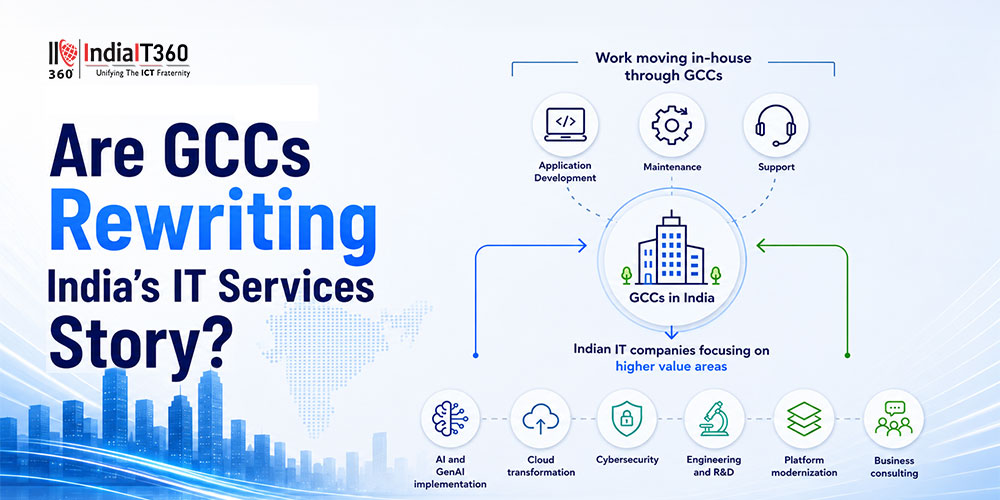
Today, global companies are increasingly bringing application development, engineering, cloud, cybersecurity, data, AI, and other technology functions closer to their own organisations through Global Capability Centres (GCCs). At the same time, Indian IT Services companies are moving further up the value chain, expanding their focus from traditional application management and support towards AI and GenAI, Cloud Transformation, Cybersecurity, Engineering and R&D, Platform Modernisation and Business Consulting.
So, is one model replacing the other?
Not quite.
What is happening is more interesting. The value chain itself is being rearranged.
Why Are GCCs in India Bringing More Technology Work In-House?
The first question is perhaps the most important one. Why are companies that have relied on external technology partners for years increasingly building capabilities of their own?
The answer lies partly in the changing nature of technology.
When software was primarily about maintaining applications, managing infrastructure, and delivering projects efficiently, outsourcing offered an obvious advantage. But technology has moved much closer to the core of business strategy. AI models influence products. Data shapes decisions. Cybersecurity affects business continuity. Cloud architecture determines scalability. Product engineering can directly influence revenue.
For companies competing in these areas, owning the capability can become strategically important.
The numbers tell the story. According to the latest Nasscom-Zinnov GCC Landscape 2026, India has 2,117 GCCs operating across 3,728 units, employing approximately 2.36 million professionals and generating $98.4 billion in revenue in FY26. The number of GCCs in India has grown by 32% since FY2021.
More importantly, these centres are not simply getting bigger. They are taking on more consequential work.
A recent report from Zinnov and Awfis describes India's GCC ecosystem as moving from traditional execution roles towards product ownership, innovation, and technology leadership. The same shift is visible in hiring. GCCs added nearly 200,000 net employees in FY26, compared with around 110,000 additions by IT services firms, and are estimated to account for 30–35% of India's AI-related hiring.
That is a significant change in where high-value technology work is being created.
But Does That Mean IT Services Companies Are Losing Their Edge?
This is where the story needs more nuance.
It would be easy to look at the rise of Global Capability Centres and conclude that traditional IT Services Companies are being displaced. The reality is more complicated.
The demand for technology services has not disappeared. If anything, it is becoming more complex.
Enterprises still need partners that can bring together industry expertise, technology platforms, implementation capabilities, cybersecurity, managed services, and transformation experience across multiple geographies. What is changing is the nature of the work they are willing to outsource and, equally importantly, what they expect from a technology partner.
The traditional question was often, "Can you deliver this project efficiently?"
The new question is increasingly the following: "Can you help us transform the business?"
That distinction is pushing India's IT services industry towards higher-value engagements and a broader focus on Enterprise Transformation.
PwC's analysis of IT services within GCCs describes the evolution clearly. As GCCs become strategic partners to their headquarters, their technology functions are increasingly focused on business transformation, innovation, growth, and competitive advantage, with portfolios spanning IT, business process management, and engineering R&D.
The opportunity for Indian IT Services companies, therefore, is not simply to compete with GCCs for the same work.
It is to become the transformation partner that helps enterprises build, scale, and modernise those capabilities.
The New Battleground Is AI, Cloud, and Engineering
The shift is particularly visible in the areas where technology is moving fastest.
AI and GenAI implementation is becoming a major growth opportunity as organisations move from experimentation towards production-grade use cases. Indian IT companies can play a role in building AI applications, integrating models into enterprise systems, managing data pipelines, and putting governance around these deployments.
Cloud Transformation is another area where the conversation has moved beyond migration. Enterprises now need help managing hybrid environments, modernising applications, controlling costs, and building cloud-native platforms.
Then comes Cybersecurity. As organisations bring more technology and data into digital environments, the security challenge becomes more complex. IT service providers with deep expertise across identity, cloud security, threat detection, resilience, and compliance can become strategic partners rather than simply managed-service vendors.
The same applies to Engineering and R&D.
GCCs are increasingly taking ownership of product engineering and research, but the ecosystem around these centres also creates opportunities for specialist technology companies, engineering firms, cloud providers, and transformation partners.
The market is therefore becoming less about who owns the work and more about who can create the greatest value around it.
From Execution Partner to Transformation Partner
This may be the most important change for India's IT Services Industry.
For years, scale was one of its biggest competitive advantages. Large teams could execute complex projects across multiple locations and time zones. That remains valuable, but AI is changing the economics of technology delivery.
Reuters reported this week that India's $315 billion IT services sector is increasingly moving towards outcome-based and performance-linked contracts, as clients demand higher productivity and greater value for their technology spend. The same report highlights how AI is reducing the value of traditional employee-heavy delivery models and increasing competition from more agile technology companies.
That makes the traditional pyramid model harder to sustain.
The winners will increasingly be companies that can combine technology expertise, domain knowledge, intellectual property, automation, and measurable business outcomes.
In other words, fewer conversations about hours and headcount. More conversations about results.
What Does This Mean for Indian IT Companies?
The answer is not to fight the GCC model.
It is to evolve alongside it.
GCCs bring technology capabilities closer to global enterprises. IT services companies can help those enterprises build and scale those capabilities faster. In many cases, the relationship may even become collaborative, with service providers supporting GCCs through specialist expertise, platforms, implementation, Cybersecurity, Cloud Transformation, and Enterprise Transformation services.
This is already visible in the way the Indian technology ecosystem is developing.
GCCs are becoming important buyers of technology and talent. IT Services Companies are developing new capabilities to serve more complex enterprise requirements. Startups are building specialised solutions. Cloud and cybersecurity providers are creating new platforms. System integrators are moving towards consulting-led engagements.
The result is not a smaller technology ecosystem.
It is a more specialised one.
What Should Enterprise Technology Leaders Look For?
For CIOs and CTOs, this shift creates both opportunity and a new procurement challenge.
The choice is no longer simply between building internally and outsourcing externally.
It is about deciding what should be owned, what should be partnered on, and where specialised expertise can drive better business outcomes.
A GCC may make sense for a strategic capability that requires deep institutional knowledge and long-term ownership. A technology partner may make more sense when an organisation needs specialist expertise, faster implementation, or access to capabilities that would take years to build internally.
The strongest technology operating models may ultimately combine both.
That means enterprise leaders need to evaluate technology partners on more than scale. Their ability to bring innovation, industry understanding, engineering depth, AI and GenAI capabilities, Cybersecurity expertise, and measurable outcomes will become increasingly important.
This is where Technology Transformation becomes critical. The right partner is no longer simply the one that can execute technology projects. It is the one that can help an enterprise turn technology investments into measurable business outcomes.
India's IT Story Is Not Ending. It Is Moving Up
The rise of Global Capability Centres has undoubtedly changed the competitive landscape for India's IT Services Industry. But it has also created a powerful incentive for the ecosystem to evolve.
India's technology advantage was never built only on cost.
It was built on talent, scale, engineering capability, and the ability to solve increasingly complex technology problems.
Those strengths remain relevant.
What is changing is where they create value.
GCCs are bringing more strategic technology work in-house. Indian IT companies are moving towards higher-value services. AI and GenAI are reshaping delivery models. Cloud Transformation is changing infrastructure. Cybersecurity is becoming a boardroom priority. Engineering and R&D are moving closer to the centre of business strategy.
The next chapter of India's IT story will therefore not be about choosing between GCCs and IT services.
It will be about how both evolve.
The winners will be those who move beyond execution and become true transformation partners.
And for India's technology ecosystem, that could be the most important shift of all.
Why This Matters for IndiaIT360
This transformation is also changing the conversations that technology leaders need to have with each other.
The questions around GCCs, AI, Cloud Transformation, Cybersecurity, Engineering and R&D, Platform Modernisation and Business Consulting are no longer separate technology conversations. They are increasingly part of one larger question: how should enterprises build technology capabilities that create measurable business value?
That is where IndiaIT360's role becomes important.
Through its CIO, CXO, OEM, Channel, and Industry Connect initiatives, IndiaIT360 brings together the different sides of the ICT ecosystem, helping technology decision-makers, technology providers, service partners, and emerging innovators understand where the market is moving and where new opportunities are being created.
For IT leaders, the value is not simply in knowing that GCCs are growing. It is in understanding what that growth means for technology partnerships, enterprise transformation, and the future of India's IT ecosystem.
And that conversation is only getting started.
The Bigger Picture
India's IT Services Industry built its global reputation by excelling at execution.
The next opportunity is to become exceptionally good at Enterprise Transformation.
GCCs are changing the nature of demand. AI is changing the economics of delivery. Enterprises are demanding outcomes instead of effort. And technology leaders are looking for partners that can help them navigate increasingly complex environments.
The companies that recognise this shift early will not simply compete for the work that remains.
They will help define what the next generation of technology work looks like.
For a deeper look at how this shift is changing the way organisations measure GCC success, read our earlier Our Desk analysis on Measuring GCC Impact: From Cost Savings to Business Value.

Related Posts
 Team IndiaIT360

eBook
Tech Titans Speak






















Poll of the Week
What’s your biggest challenge in scaling your SaaS platform?
Which VDI platform do you currently use or prefer using?
What is driving your organization to reconsider its VDI strategy today?
What would help you grow your business faster as a channel partner?
How ready is your payments ecosystem for AI-driven automation?
What matters most in your cloud journey?
What's your biggest IT headache?
How do you prefer to stay updated on emerging tech trends?
Which breakthrough technology would most elevate your endpoint security?

Ad
Teaser of the Week