Leaders Tech Talk: 𝗛𝗼𝗹𝗶 𝗶𝘀𝗻’𝘁 𝗿𝗮𝗻𝗱𝗼𝗺 𝗰𝗵𝗮𝗼𝘀. 𝗧𝗵𝗲𝗿𝗲’𝘀 𝗮𝗰𝘁𝘂𝗮𝗹𝗹𝘆 𝗮 𝗽𝗿𝗼𝗰𝗲𝘀𝘀 𝗯𝗲𝗵𝗶𝗻𝗱 𝘁𝗵𝗲 𝗰𝗲𝗹𝗲𝗯𝗿𝗮𝘁𝗶𝗼𝗻.


Ad


The Silent Revolution in Manufacturing: How Technology Is Redefining India’s Industrial Backbone
-
 Team IndiaIT360
- 03-Jan-2026
- 1906 Views
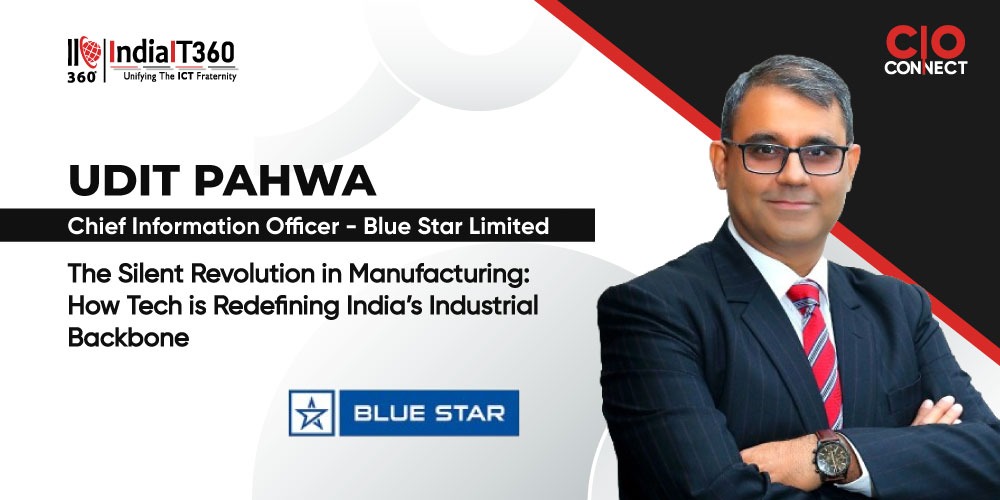
Indian manufacturing has always been a pillar of economic resilience. Today, however, it is undergoing a structural technology-based shift. This silent revolution, powered by digital technologies, is redefining how Indian manufacturing enterprises create value, manage risk, and compete globally at scale.
From a Board and CXO perspective, this transformation is no longer about incremental efficiency gains or isolated connected technology projects of the manufacturing shopfloor. It is about long-term competitiveness, operational resilience, and capital productivity.
Having spent nearly three decades in manufacturing and currently serving as CIO of Blue Star Limited, I have seen technology evolve from a back-office enabler to a strategic growth and efficiency lever. What distinguishes the current phase is the convergence of data, connectivity, and intelligence across the end-to-end value chain.
 Advertisement
Technology as a Strategic Asset, Not an IT Function
Manufacturing leaders are moving beyond traditional automation towards intelligent operations. AI-driven demand forecasting, predictive maintenance, digital quality management, and energy optimisation are now directly influencing EBITDA, working capital, and asset utilisation.
More importantly, these capabilities are changing how leadership teams make decisions. Real-time visibility across plants and supply chains allows faster course correction, scenario planning, and risk mitigation—capabilities that Boards increasingly expect, especially in volatile macroeconomic environments.
Building the Connected Manufacturing Enterprise
The next frontier is enterprise integration. Manufacturing excellence can no longer exist in silos—plant, sales, procurement, logistics, product development, R&D, and finance must operate as a single, digitally connected system.
Cloud platforms, Industrial IoT, and API-based integration are enabling this shift. For Boards, this connectivity translates into greater transparency, traceability, and compliance—critical for ESG commitments, regulatory adherence, and global customer expectations.
However, this also raises the bar on cybersecurity, data governance, and resilience. As operational technology converges with IT, cyber risk becomes business risk. “Security by design” must therefore be embedded into every digital initiative, not treated as an afterthought.
Workforce Transformation and Change Leadership
A key board-level question is whether technology will displace jobs. In practice, successful transformations demonstrate the opposite. Digital manufacturing elevates human roles—from manual supervision to data-driven decision-making. It enhances the capability to make more effective decisions.
The real challenge lies in enabling change management, user adoption, and skills capability building. Investments in technology must be matched by investments in skill development, leadership alignment, and cultural adoption. Without this, even the best platforms fail to deliver value.
India’s Opportunity—and Responsibility
India is uniquely positioned to lead this transformation. A strong domestic market, policy support through initiatives like Make in India, and a digitally fluent workforce provide a significant advantage.
Yet, the winners will be those organisations that move decisively from pilots to enterprise-wide digital operating models, with clear ownership, measurable outcomes, and Board-level sponsorship.
Conclusion
The silent revolution in manufacturing is not about technology for its own sake. It is about building future-ready, resilient, and globally competitive enterprises.
For CXOs and Boards, the key question is no longer whether to invest in digital manufacturing—but how quickly and how holistically it can be scaled to become a true strategic differentiator.
Article written by Mr. Udit Pahwa, Chief Information Officer at Blue Star Limited.


Tech Titans Speak










Poll of the Week
What would help you grow your business faster as a channel partner?
How ready is your payments ecosystem for AI-driven automation?
What matters most in your cloud journey?
What's your biggest IT headache?
How do you prefer to stay updated on emerging tech trends?
Which breakthrough technology would most elevate your endpoint security?

Ad

Ad
Teaser of the Week