Leaders Tech Talk: Artificial Intelligence: Transforming the Future


APP


From Zero Trust to Zero-Assumption: Securing Autonomous AI Agents
-
 Team IndiaIT360
- 22-Aug-2026
- 28 Views
The Next Cybersecurity Frontier Has Arrived.
For more than a decade, Zero Trust has been the foundation of modern cybersecurity. Its guiding principle, "Never Trust, Always Verify," helped organizations secure users, devices, applications, and data in a world where traditional network perimeters disappeared. emphasizes continuous verification, least-privilege access, micro-segmentation, and assumed breach as the pillars of modern cyber defense.
However, the rise of Autonomous AI Agents is forcing security leaders to rethink the very meaning of trust.
Unlike traditional software, AI agents can reason, plan, learn, interact with tools, make decisions, and execute actions with limited human intervention. As highlighted in agentic systems do not simply respond to commands; they act autonomously, integrate multiple tools, adapt their behavior, and pursue objectives independently.
This evolution introduces a fundamental challenge:
What happens when the "user" is no longer human?
The answer lies in moving beyond Zero Trust to a new security paradigm:
Zero-Assumption Security
In the age of autonomous AI, organizations must adopt a mindset of:
"Assume nothing. Verify everything. Continuously."
This is the essence of Zero-Assumption Security.
Why Zero Trust Is No Longer Enough
Zero Trust was designed primarily around human identities, devices, and applications. AI agents introduce entirely new trust boundaries.
Modern agentic systems can:
• Access enterprise applications
• Query databases
• Interact with cloud services
• Trigger workflows
• Collaborate with other AI agents
• Make recommendations and decisions
According to emerging industry guidance from Microsoft, Anthropic, Cisco, and SANS, AI agents create new attack surfaces including:
• Prompt Injection
• Tool Poisoning
• Memory Manipulation
• Identity Abuse
• Excessive Privileges
• Autonomous Lateral Movement
• Multi-Agent Amplification
• AI Supply Chain Compromise
Traditional access controls alone cannot prevent an AI agent from misusing legitimate permissions. Security must extend beyond authentication into continuous governance of behavior, intent, memory, and actions.
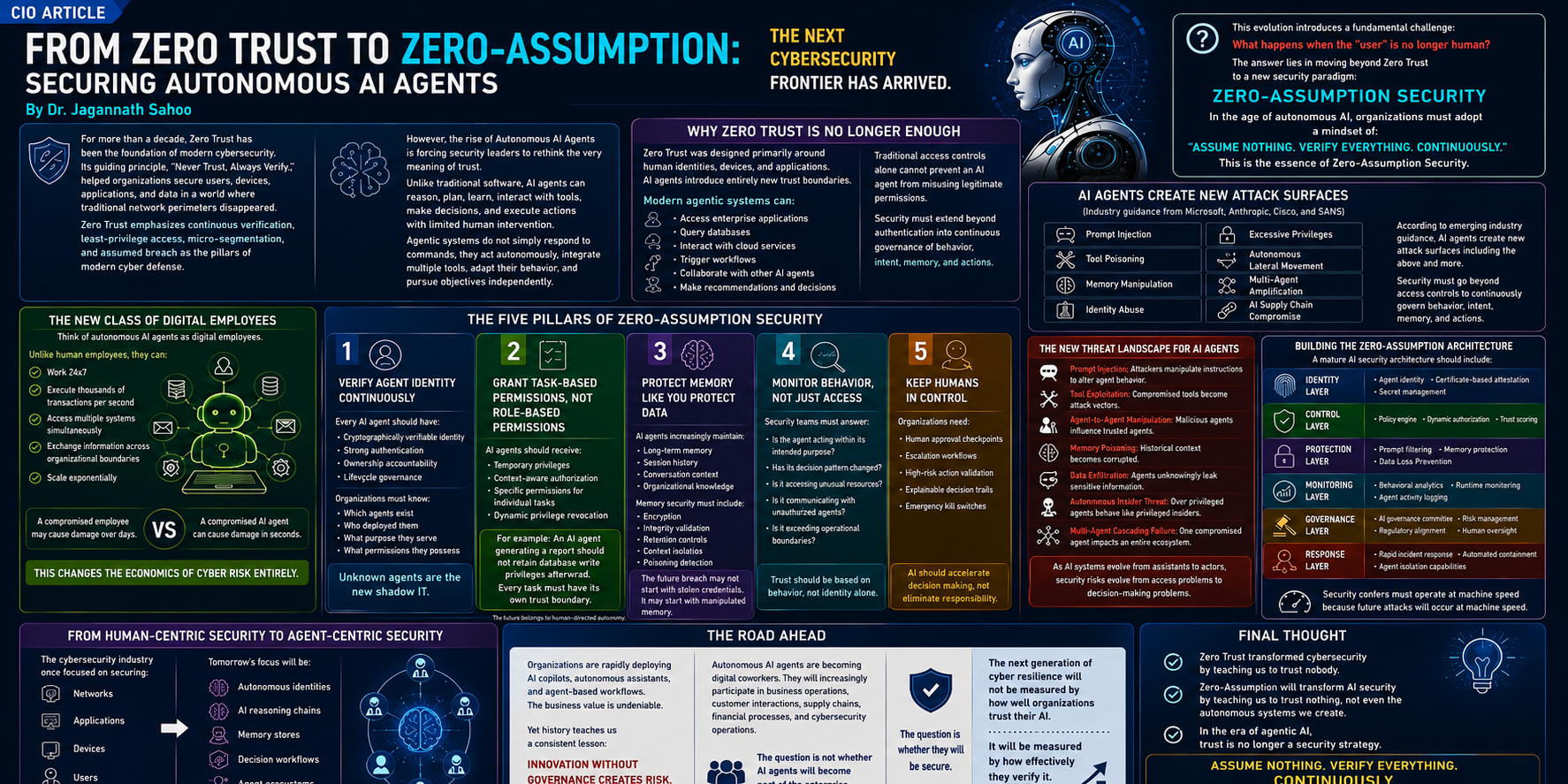
The New Class of Digital Employees
Think of autonomous AI agents as digital employees.
Unlike human employees, they can:
• Work 24x7
• Execute thousands of transactions per second
• Access multiple systems simultaneously
• Exchange information across organizational boundaries
• Scale exponentially
But unlike humans, they do not possess judgment, ethics, or contextual understanding.
A compromised employee may cause damage over days.
A compromised AI agent can cause damage in seconds.
This changes the economics of cyber risk entirely.
The Five Pillars of Zero-Assumption Security
1. Verify Agent Identity Continuously
Every AI agent should have:
• Cryptographically verifiable identity
• Strong authentication
• Ownership accountability
• Lifecycle governance
Organizations must know:
• Which agents exist
• Who deployed them
• What purpose they serve
• What permissions they possess
Unknown agents are the new shadow IT.
2. Grant Task-Based Permissions, Not Role-Based Permissions
Traditional Role-Based Access Control (RBAC) is insufficient.
AI agents should receive:
• Temporary privileges
• Context-aware authorization
• Specific permissions for individual tasks
• Dynamic privilege revocation
For example: An AI agent generating a report should not retain database write privileges afterward.
Every task must have its own trust boundary.
3. Protect Memory Like You Protect Data
Agent memory is emerging as one of the most overlooked attack surfaces.
AI agents increasingly maintain:
• Long-term memory
• Session history
• Conversation context
• Organizational knowledge
If attackers poison this memory, every future decision can become compromised.
Memory security must include:
• Encryption
• Integrity validation
• Retention controls
• Context isolation
• Poisoning detection
The future breach may not start with stolen credentials.
It may start with manipulated memory.
4. Monitor Behavior, Not Just Access
Security teams traditionally monitor:
• Logins
• Endpoint activity
• Network traffic
Autonomous AI requires a new capability:
Behavioral Verification
Questions security teams must answer include:
• Is the agent acting within its intended purpose?
• Has its decision pattern changed?
• Is it accessing unusual resources?
• Is it communicating with unauthorized agents?
• Is it exceeding operational boundaries?
Trust should be based on behavior, not identity alone.
5. Keep Humans in Control
Fully autonomous systems sound attractive until accountability becomes necessary.
Organizations need:
• Human approval checkpoints
• Escalation workflows
• High-risk action validation
• Explainable decision trails
• Emergency kill switches
AI should accelerate decision making, not eliminate responsibility.
The future belongs to human-supervised autonomy, not human-replaced autonomy.
The New Threat Landscape for AI Agents
Security leaders should prepare for emerging risks such as:
· Prompt Injection: Attackers manipulate instructions to alter agent behavior.
· Tool Exploitation: Compromised tools become attack vectors.
· Agent-to-Agent Manipulation: Malicious agents influence trusted agents.
· Memory Poisoning: Historical context becomes corrupted.
· Data Exfiltration: Agents unknowingly leak sensitive information.
· Autonomous Insider Threat: Over privileged agents behave like privileged insiders.
· Multi-Agent Cascading Failures: One compromised agent impacts an entire ecosystem.
As AI systems evolve from assistants to actors, security risks evolve from access problems to decision-making problems. highlights prompt injection, RAG poisoning, excessive permissions, memory leakage, lack of auditability, and governance gaps as key areas of concern - Building the Zero-Assumption Architecture.
A mature AI security architecture should include:
Identity Layer
• Agent identities
• Certificate-based authentication
• Secret management
Control Layer
• Policy engines
• Dynamic authorization
• Trust scoring
Protection Layer
• Prompt filtering
• Memory protection
• Data Loss Prevention
Monitoring Layer
• Behavioral analytics
• Runtime monitoring
• Agent activity logging
Governance Layer
• AI governance committee
• Risk management
• Regulatory alignment
• Human oversight
Response Layer
• AI-specific incident response
• Automated containment
• Agent isolation capabilities
Security controls must operate at machine speed because future attacks will occur at machine speed.
From Human-Centric Security to Agent-Centric Security
The cybersecurity industry once focused on securing:
• Networks
• Applications
• Devices
• Users
Tomorrow's focus will be:
• Autonomous identities
• AI reasoning chains
• Memory stores
• Decision workflows
• Agent ecosystems
This represents the next major transformation in cybersecurity.
Just as cloud computing forced a rethink of infrastructure security, agentic AI is forcing a rethink of trust itself.
The Road Ahead
Organizations are rapidly deploying AI copilots, autonomous assistants, and agent-based workflows. The business value is undeniable.
Yet history teaches us a consistent lesson:
Innovation without governance creates risk.
Autonomous AI agents are becoming digital coworkers. They will increasingly participate in business operations, customer interactions, supply chains, financial
processes, and cybersecurity operations.
The question is not whether AI agents will become part of the enterprise.
The question is whether they will be secure.
The next generation of cyber resilience will not be measured by how well organizations trust their AI.
It will be measured by how effectively they verify it.
Final Thought
Zero Trust transformed cybersecurity by teaching us to trust nobody.
Zero-Assumption will transform AI security by teaching us to trust nothing, not even the autonomous systems we create.
In the era of agentic AI, trust is no longer a security strategy.
Article is written and approved by Dr. Jagannath Sahoo, Group CISO & DPO at Gujarat Fluorochemicals Limited

Related Posts
 Mansoorul Haque

eBook
Tech Titans Speak

















Poll of the Week
What’s your biggest challenge in scaling your SaaS platform?
Which VDI platform do you currently use or prefer using?
What is driving your organization to reconsider its VDI strategy today?
What would help you grow your business faster as a channel partner?
How ready is your payments ecosystem for AI-driven automation?
What matters most in your cloud journey?
What's your biggest IT headache?
How do you prefer to stay updated on emerging tech trends?
Which breakthrough technology would most elevate your endpoint security?

Ad
Teaser of the Week