From Our Desk: Are We Still Measuring GCCs the Wrong Way?


Ad


Are We Still Measuring GCCs the Wrong Way?
-
 Team IndiaIT360
- 24-Jul-2026
- 34 Views
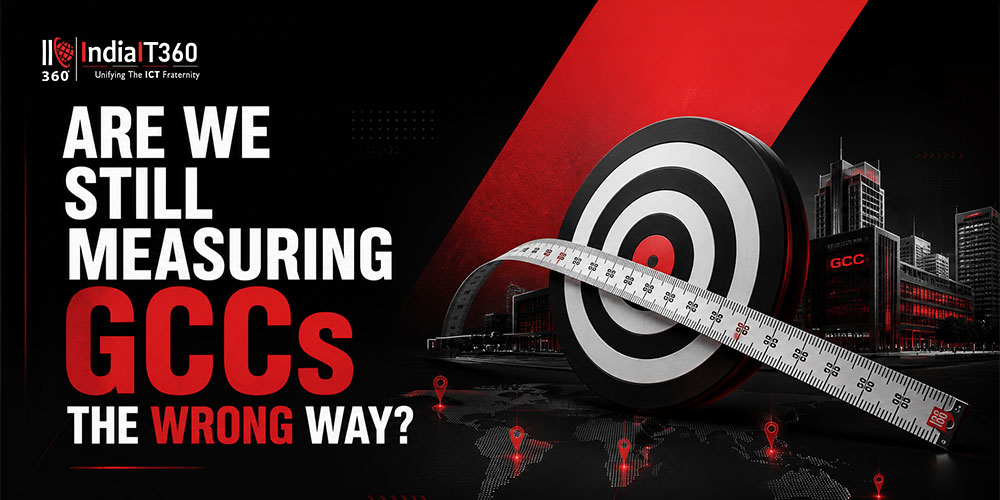
There was a time when the success of a Global Capability Centre (GCC) could be summed up in a single boardroom slide. Lower costs, higher efficiency, and faster delivery were enough to justify investments and demonstrate impact. For decades, this model worked well, helping India establish itself as the preferred destination for multinational companies looking to scale operations while maintaining operational excellence.
But business priorities have changed dramatically over the last few years. Companies are navigating economic uncertainty, accelerating digital transformation, investing in intelligent technologies, and competing in markets where innovation often matters more than efficiency. In such an environment, can a capability centre still be judged only by how much money it saves?
That question is becoming increasingly difficult to answer.
Today's Global Capability Centres are no longer confined to supporting business operations. They are designing products, building digital platforms, driving engineering excellence, strengthening cybersecurity, creating intellectual property, and shaping enterprise-wide technology strategies. Their contribution extends far beyond operational support, making traditional performance metrics look increasingly outdated.
The conversation has quietly shifted from cost optimisation to business impact, and in many ways, that change represents the next chapter of India's GCC success story.
Beyond Cost Optimisation, Towards Business Transformation
The evolution of India's GCC ecosystem has been remarkable. What started as a shared services model has transformed into one of the world's most sophisticated innovation ecosystems.
According to the latest Nasscom and Zinnov estimates, India is now home to more than 2,100 Global Capability Centres, employing over 2.3 million professionals. Together, these centres contribute significantly to global engineering, research, product development, analytics, cybersecurity, cloud computing, and enterprise technology initiatives.
This growth is no accident.
Global organisations have realised that India's advantage extends well beyond cost competitiveness. It lies in access to highly skilled talent, deep technology expertise, and the ability to solve complex business challenges at scale. As a result, responsibilities that were once retained at headquarters are increasingly being entrusted to teams based in India.
The shift is visible across industries. Banking, healthcare, manufacturing, retail, telecom, automotive, life sciences, and financial services are all expanding the strategic role of their GCCs, not because they reduce expenses, but because they create measurable business value.
The Real Question Is No Longer "How Much Did We Save?"
Every business wants efficiency. That will never change.
But efficiency eventually becomes an expectation rather than a differentiator.
Business value, on the other hand, continues to create competitive advantage.
Consider a capability centre that develops an AI-powered fraud detection system capable of preventing financial losses worth millions of dollars. Another team redesigns customer onboarding, reducing processing time from days to minutes. An engineering centre develops a cloud-native product that opens an entirely new revenue stream for the business. A cybersecurity team identifies vulnerabilities before they evolve into major security incidents.
None of these achievements can be measured simply by calculating operational savings.
They represent innovation.
They create resilience.
Most importantly, they influence business growth.
This is why leading enterprises are redefining GCC performance metrics. Instead of evaluating centres solely through productivity, utilisation, or cost reduction, organisations are increasingly measuring innovation, product ownership, customer outcomes, digital capabilities, intellectual property creation, and enterprise-wide impact.
These indicators paint a far more accurate picture of what a modern capability centre contributes.
Why Technology Is Reshaping the GCC Story
The rise of Artificial Intelligence, cloud computing, advanced analytics, automation, and cybersecurity has fundamentally changed enterprise priorities.
Businesses today are investing in intelligent platforms that help them make faster decisions, improve customer experiences, strengthen resilience, and accelerate innovation. These technologies require multidisciplinary teams capable of combining technical expertise with business understanding.
That capability increasingly exists within India's GCC ecosystem.
According to PwC India's latest GCC report, the sector is expected to continue growing at an annual rate of 11–12?tween FY25 and FY29, driven by increasing ownership of high-value functions such as product engineering, data science, digital platforms, AI, and enterprise transformation.
This growth demonstrates an important reality.
Companies are not expanding their GCCs simply because India offers operational efficiency.
They are investing because these centres have become strategic innovation partners.
Technology is no longer enabling GCCs.
It is redefining their purpose.
Measuring Business Value Requires a Different Mindset
One of the biggest challenges organisations face today is that business value cannot always be captured through traditional dashboards.
Operational metrics are straightforward. Cost savings can be calculated. Productivity percentages can be compared. Delivery timelines can be monitored.
Innovation is different.
Its impact often becomes visible over time.
A new engineering framework may reduce development cycles for years to come. A cybersecurity initiative may prevent risks that never become visible. A product designed in India may strengthen customer loyalty across multiple global markets. A cloud migration programme may improve organisational agility in ways that cannot be immediately quantified.
These outcomes are strategic rather than operational.
That is why boardrooms are increasingly asking different questions.
How many digital products originated from the GCC?
How much faster are innovation cycles today than they were three years ago?
How much intellectual property has been created?
How effectively are India's engineering teams influencing global business decisions?
These questions are harder to answer, but they reveal far more about long-term enterprise value than operational efficiency alone.
Talent Is Becoming the Strongest Business Metric
Technology evolves rapidly.
Talent determines how quickly organisations can evolve with it.
India's ability to attract world-class engineers, cybersecurity professionals, cloud architects, AI specialists, product managers, and digital transformation leaders continues to make it the preferred destination for multinational organisations expanding their Global Capability Centres.
Increasingly, these professionals are not only building technology but also leading global teams, defining enterprise architecture, shaping product strategy, and influencing business decisions at the highest level.
The conversation has therefore shifted from reducing operational costs to building organisational capabilities.
That distinction may seem subtle, but it fundamentally changes how businesses view their investments in India.
Why This Matters to Every Enterprise
The transformation of Global Capability Centres reflects a larger shift taking place across the technology industry.
Businesses today compete on innovation rather than scale alone.
Customer experience matters as much as operational efficiency.
Cyber resilience has become just as important as growth.
Data-driven decision-making is influencing boardroom strategy.
Cloud platforms, intelligent automation, engineering excellence, and digital transformation are increasingly interconnected.
These are also the conversations taking place across IndiaIT360's Executive Roundtables, where technology leaders explore how enterprises can build future-ready organisations by combining infrastructure, security, data, cloud, and emerging technologies into measurable business outcomes.
For professionals looking to understand these evolving trends, the Our Desk section on IndiaIT360 brings together perspectives on enterprise technology, leadership, cybersecurity, cloud computing, AI, and the changing role of Global Capability Centres in shaping the future of business. Explore more insights here: https://indiait360.com/blog/type/3
The Future Will Belong to Value Creators
India has already demonstrated that it can build one of the world's largest and most successful GCC ecosystems.
The next phase of growth will not be defined by how efficiently work is delivered.
It will be defined by how effectively these centres create business value.
The organisations that will lead tomorrow are unlikely to ask whether their Global Capability Centres reduced costs this quarter.
Instead, they will ask whether those centres accelerated innovation, improved customer experience, strengthened resilience, created intellectual property, and helped the business stay ahead of disruption.
That is a far more meaningful measure of success.
Because in today's economy, cost optimisation may open the door.
But business value is what secures a permanent seat at the table.

 Team IndiaIT360

eBook
Tech Titans Speak






































Poll of the Week
What’s your biggest challenge in scaling your SaaS platform?
Which VDI platform do you currently use or prefer using?
What is driving your organization to reconsider its VDI strategy today?
What would help you grow your business faster as a channel partner?
How ready is your payments ecosystem for AI-driven automation?
What matters most in your cloud journey?
What's your biggest IT headache?
How do you prefer to stay updated on emerging tech trends?
Which breakthrough technology would most elevate your endpoint security?

Ad
Teaser of the Week