APP


Breaking the Dependency Cycle: Why Indian Enterprises Must Embrace Home-Grown Cloud Solutions
-
 Team IndiaIT360
- 08-Jan-2026
- 2167 Views
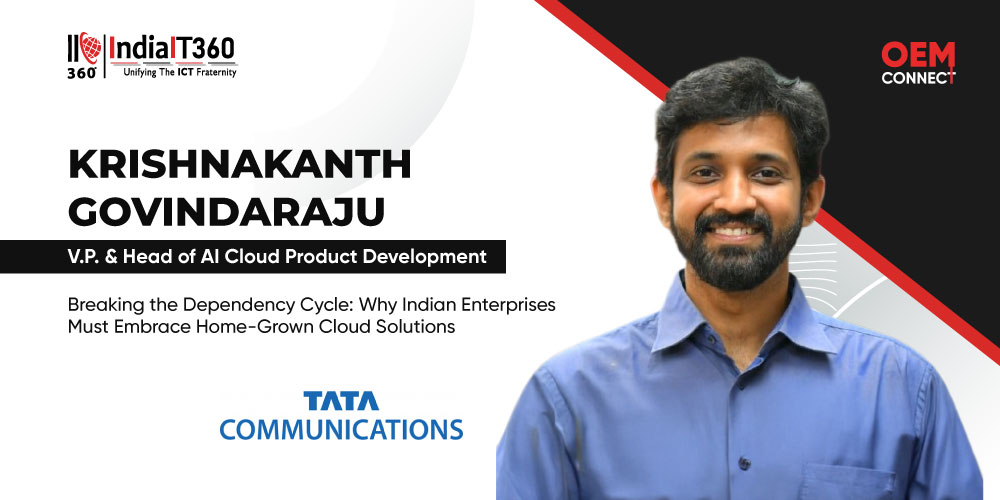
The word Swadeshi has deep roots in Indian culture. First coined between 1905 and 1908 during the colonial period, it symbolised self-reliance and resistance through the adoption of home-grown products. While the early Swadeshi movement found widespread acceptance, economic liberalisation and globalisation gradually shifted preferences toward foreign-made solutions.
Today, this philosophy is re-emerging in a new form through digital Atmanirbharta. As Indian enterprises accelerate their digital transformation, cloud infrastructure decisions are no longer driven only by cost or scale. They increasingly reflect deeper concerns around control, governance, resilience, and national interest.
The Problem: Over-Reliance on Foreign Cloud Infrastructure and Its Pitfalls
India’s cloud adoption journey has matured significantly. Early conversations focused on affordability, elasticity, and storage location. While data residency remains important, enterprises are now asking more fundamental questions. Who governs the platform? Which legal framework applies during disputes or crises? Where does operational authority truly reside?
This evolution reflects real risk. According to a 2024 MeitY-backed assessment, over 70 percent of Indian enterprises store sensitive data on foreign cloud infrastructure. Even when data is hosted in Indian data centres, governance and access policies remain subject to foreign jurisdictions. This gap between physical location and legal control is becoming increasingly visible to enterprises operating in regulated sectors.
Recent developments have further highlighted this vulnerability. In 2025, an Indian enterprise operating in a critical sector experienced a brief suspension of essential enterprise IT services following international sanctions imposed on its overseas shareholder. Although services were subsequently restored and operations stabilised, the incident caused immediate disruption and underscored a larger concern: Indian businesses can be directly impacted by geopolitical or regulatory actions taken outside the country, even when their operations and users are entirely domestic.
Global hyperscalers continue to play a critical role in India’s digital economy. However, local presence alone does not guarantee local accountability. As regulatory scrutiny intensifies, governance alignment is emerging as a decisive factor in cloud strategy.
Dependency, Governance, and Long-Term Risk
Cloud infrastructure is now foundational to business continuity. Heavy dependence on foreign-governed platforms introduces risks that enterprises cannot directly influence. These include exposure to external policy changes, foreign surveillance laws, geopolitical tensions, and sudden compliance shifts.
Vendor lock-in further compounds the challenge. Once enterprises deeply embed workloads into a single foreign ecosystem, switching becomes complex, costly, and operationally disruptive. This dependency weakens strategic flexibility and increases long-term risk.
Domestic cloud platforms are not positioned as replacements, but as stabilisers. They provide clearer jurisdictional alignment and governance transparency, especially for mission-critical and regulated workloads where accountability cannot be ambiguous.
Data Sovereignty from Compliance to Confidence
For sectors such as BFSI, healthcare, government, and critical infrastructure, data sovereignty has moved beyond regulatory compliance. It is now about institutional trust and operational assurance.
When sensitive data falls under foreign jurisdiction, compliance becomes layered and uncertain. Auditability, access control, and legal recourse are harder to guarantee as India’s data protection framework evolves.
Cloud platforms governed within India align data access, monitoring, and accountability under Indian law. This includes not only data residency but also governance of metadata, access policies, and control mechanisms. Such alignment simplifies compliance with Indian regulatory bodies including MeitY, RBI, SEBI, and IRDAI, strengthens confidence, and reduces regulatory ambiguity for enterprises navigating complex oversight environments.
Operational Resilience, Cost Predictability, and Cyber Risk
Operational resilience is no longer theoretical. India recorded approximately 265 million cyberattacks in 2025 according to The Times of India, based on the Seqrite India Cyber Threat Report 2026. The Times of India. This highlights the urgency for secure, transparent, and locally governed digital infrastructure.
Beyond security, enterprises are also reassessing cost structures. Hidden expenses related to data egress, cross-border transfers, currency fluctuations, and sudden pricing revisions often widen the gap between perceived and actual cloud costs.
 Advertisement
Indian enterprises increasingly prioritise predictable pricing, local support, and total cost visibility over headline rates. Domestically governed cloud platforms help address this by reducing wastage through optimised capacity planning and enabling meaningful reductions in total cost of ownership. For advanced workloads such as AI and analytics, locally optimised GPU infrastructure can also deliver comparable performance at significantly lower cost, improving both efficiency and scalability.
The Opportunity a Balanced and Self-Reliant Cloud Ecosystem
India’s cloud market is expected to cross USD 24 billion by 2028, with the Infrastructure-as-a-Service segment projected to nearly triple by 2030. This growth presents an opportunity to design a more balanced cloud ecosystem.
Atmanirbharta in cloud computing does not mean excluding global providers. It means reducing over-dependence by combining hyperscaler strengths with domestically governed platforms that understand Indian regulatory, scale, and performance realities.
Hybrid and multi-cloud strategies are becoming the norm, allowing enterprises to place workloads based on sensitivity, compliance, and criticality rather than defaulting to a single provider.
Introducing Tata Communications Vayu Cloud: A Homegrown, Enterprise-Ready Platform
Tata Communications Vayu Cloud represents a truly Indian cloud platform designed for enterprise-grade requirements and Indian regulatory alignment.
Built and operated in India, Tata Communications Vayu Cloud ensures that customer data and metadata are hosted, processed, and governed entirely within the country. With a fully India-based control plane, the platform offers greater transparency, enabling enterprises to meet audit and regulatory requirements with clarity and confidence. Governance, access, and oversight remain aligned with Indian legal and compliance frameworks.
Tata Communications Vayu Cloud integrates cloud, edge networking, security, and AI-ready infrastructure within a unified environment, reducing integration complexity and reliance on multiple vendors. Its infrastructure footprint spans 8 data centres across India, offering comprehensive geographic coverage and low-latency performance for mission-critical and latency-sensitive applications, capabilities that few global providers can match within a single, domestically governed platform.
With transparent pricing, FinOps controls, and optimised GPU infrastructure, Tata Communications Vayu Cloud supports both operational efficiency and digital self-reliance. Enterprises adopting the platform can achieve meaningful reductions in total cost of ownership while maintaining high levels of reliability, performance, and compliance confidence.
Why Now?
India is at a turning point.
Digital services are expanding, AI and analytics workloads are rising, and enterprises are taking data governance more seriously than ever. Foreign cloud dependency no longer aligns with these priorities. A domestic platform like Tata Communications Vayu Cloud provides the sovereignty compliance, and performance required for the next decade of digital transformation.
Conclusion: India Must Own Its Digital Future
India’s digital future will be built on a diverse and resilient cloud ecosystem. Global hyperscalers, domestic platforms, and hybrid architectures will coexist.
What is changing is the evaluation lens. Enterprises are increasingly assessing cloud platforms based on governance, jurisdictional clarity, operational resilience, and long-term risk.
Home-grown cloud platforms add a critical dimension to this strategy. They enable digital Atmanirbharta by aligning infrastructure with India’s regulatory environment, business realities, and national priorities. For enterprises planning the next phase of digital growth, this alignment is no longer optional. It is strategic.
Article written by Mr. Krishnakanth Govindaraju, Vice President & Head of AI Cloud Product Development at Tata Communications


 Team IndiaIT360

eBook
Tech Titans Speak

































Poll of the Week
What’s your biggest challenge in scaling your SaaS platform?
Which VDI platform do you currently use or prefer using?
What is driving your organization to reconsider its VDI strategy today?
What would help you grow your business faster as a channel partner?
How ready is your payments ecosystem for AI-driven automation?
What matters most in your cloud journey?
What's your biggest IT headache?
How do you prefer to stay updated on emerging tech trends?
Which breakthrough technology would most elevate your endpoint security?

Ad
Teaser of the Week